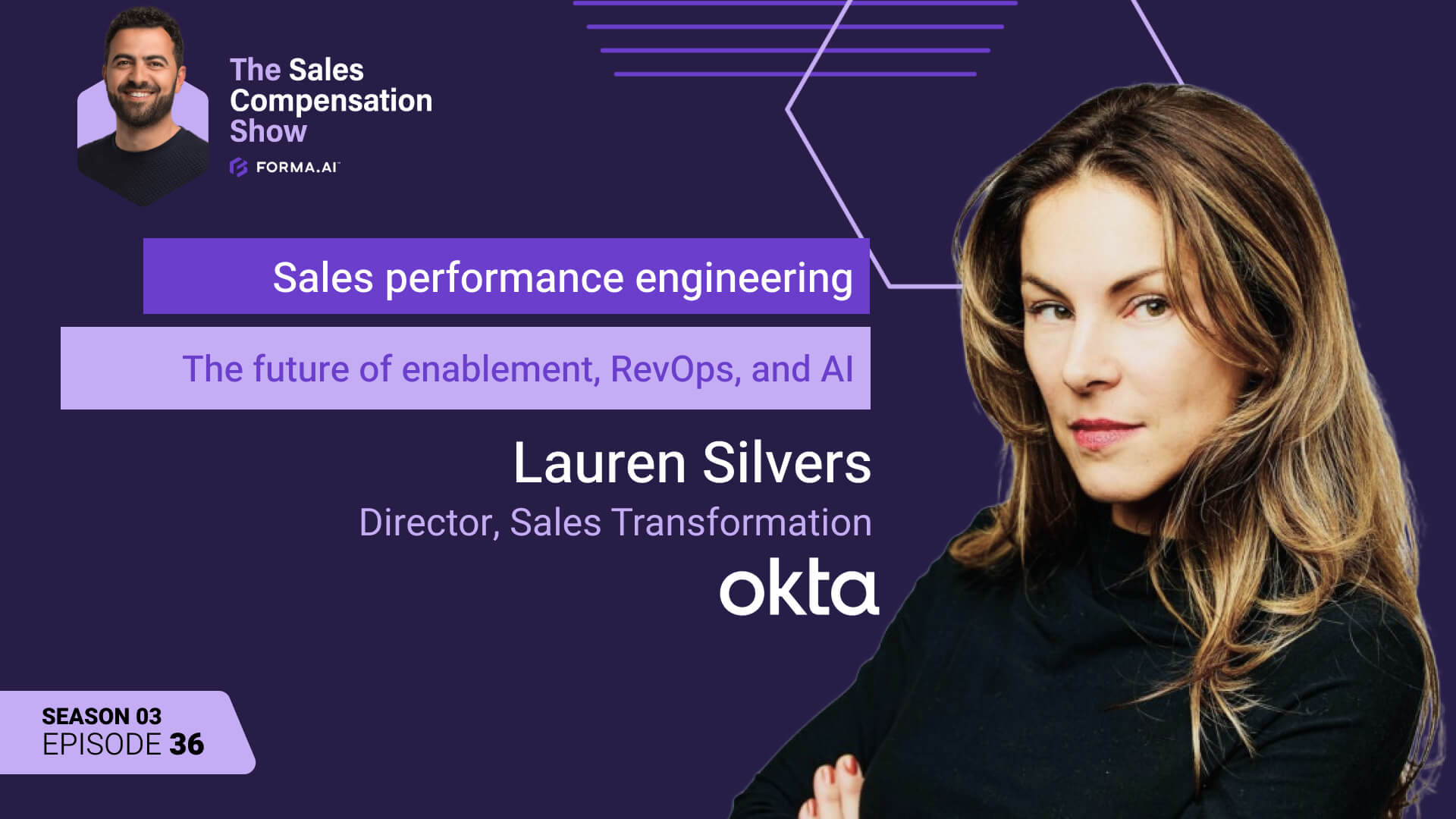
From enablement to sales performance engineering: Okta's Lauren Silvers on what's next
From enablement to sales performance engineering: Okta's Lauren Silvers on what's next
Lauren Silvers explains how revenue leaders can redesign sales performance, apply AI effectively, and measure what drives results.


From enablement to sales performance engineering: Okta's Lauren Silvers on what's next
Lauren Silvers explains how revenue leaders can redesign sales performance, apply AI effectively, and measure what drives results.
From enablement to sales performance engineering: Okta's Lauren Silvers on what's next
Lauren Silvers explains how revenue leaders can redesign sales performance, apply AI effectively, and measure what drives results.
From enablement to sales performance engineering: Okta's Lauren Silvers on what's next
Lauren Silvers explains how revenue leaders can redesign sales performance, apply AI effectively, and measure what drives results.
What does comparative literature have to do with sales enablement leadership?
For Lauren Silvers, Director of Sales Transformation at Okta, the connection is strong systems thinking.
Her background in comparative literature taught her to examine disciplines that don't naturally connect, understand how each operates, and find the unlikely relationships between them. Today, she applies this same lens across enablement, RevOps, data, and sales leadership.
And this ability (connecting functions often managed in isolation) is becoming increasingly valuable.
GTM organizations are being asked to produce more with AI,all while proving that every new tool, program, and seller activity is improving performance. Yet the functions surrounding the seller are still frequently managed as separate workstreams, leaving the seller to connect the dots.
In this episode of The Sales Compensation Show, Forma.ai CEO Nabeil Alazzam speaks with Lauren about what a more connected model requires and how she pulls this off in practice.
Their conversation explores how leaders can align organizations around change, Lauren's take on how enablement is evolving, and how AI is making human judgment the most important part of the puzzle.
Below are some of our favorite takeaways. You can catch the full episode on Spotify and Apple Podcasts.
Episode resources
- Connect with Lauren on LinkedIn
- Lauren's book recommendation: Naked Sales: How Design Thinking Reveals Customer Motives and Drives Revenue by Ashley Welch and Justin Jones
Always diagnose the performance system issue before prescribing the fix
Lauren’s systems perspective leads to an important starting point for the entire conversation. That is, before investing in AI tools or redesigning how sellers are measured, leaders first need to understand what is actually preventing the organization from performing. It sounds obvious, but it's where many sales transformations go wrong from the start.
Sales transformation typically begins when a lagging indicator moves in the wrong direction. Growth slows, or win rates drop. Churn rises. Leadership sees the result and reaches for a new tool, incentive, or training program for the fix. Lauren’s instinct, however, is to pause and inspect the entire flow.
This is because the same performance outcome can be caused by very different obstacles or constraints. Unless you understand where the system is breaking, you run the risk of applying a credible solution to the wrong problem altogether.
As an example, consider a company that has introduced a new discovery methodology but sees little improvement in conversion. The first conclusion may be that sellers need more training, but a closer look could reveal that sellers already understand the methodology. The breakdown is happening after training:
- Product marketing may still provide pitch-focused materials that doesn't support discovery.
- Managers are inspecting activity and pipeline movement rather than the quality of customer conversations.
- Sellers have to move between disconnected tools to find the context needed to apply the methodology.
- Incentives continue to reward short-term volume over deal quality.
In this case, what initially looked like a seller skill gap on the surface, was actually a reinforcement problem. More training would add time and effort without changing the conditions sellers return to. The more effective intervention is to align the wider system: update the provided sales-enablement materials, change what managers inspect, embed relevant context directly into the workflow, and ensure incentives don't inadvertantly pull sellers in another direction.
Which is why Lauren shares she typically starts her approach to revenue optimization by looking for variability.
- Where is execution already working better?
- What are successful teams, managers, or sellers doing differently?
- Which behaviors appear to move an important leading indicator?
- And what prevents the rest of the organization from repeating said behaviors?
Ultimately, the goal is to identify the broken link between the business outcome and the behavior expected to produce it:
Desired behavior → leading indicator → business outcome
If sellers are demonstrating the behavior but the leading indicator isn't moving, the original hypothesis may be wrong. If the behavior is not changing, leaders need to determine whether the obstacle is skill, management, process, data, tooling, or incentives. Only then can you select an intervention.
That discipline keeps leaders from overcorrecting at the most visible part of the system while leaving a real constraint untouched. It also sets up the broader shift Lauren describes throughout the episode: from delivering isolated programs to engineering the conditions in which better performance can actually take hold.
The future of sales enablement is sales performance engineering
Based on what she’s seeing both in-market and in-seat at Okta, Lauren has a clear perspective on where the sales enablement discipline is headed. One of her strongest predictions is that enablement is moving beyond exceptionally-researched training delivery and toward sales performance engineering.
Learning expertise will still matter, and enablement teams will continue to help sellers build skills, adopt new approaches, and translate knowledge into behavior. But Lauren sees that the next mandate is even broader.
Enablement leaders will need to further understand what drives seller productivity across systems, tools, people, and processes and eliminating obstacles preventing them from applying it efficiently in the flow of work.
The constraint may be a skill gap. But it may also be:
- Administrative work consuming seller capacity
- Disconnected tools and fragmented account context
- Meetings or internal processes crowding out customer-facing, revenue-generating work
- Guidance that sits outside the seller’s workflow
- Competing priorities reinforced by managers or sales incentives
In other words, improving performance will increasingly require enablement professionals to help redesign the environment surrounding the seller.
It's also why Lauren believes AI fluency and systems thinking will become essential career skills for today's enablement professionals. The opportunity is to understand how AI and agentic workflows can remove repetitive work, connect information, and build systems that scale.
Lauren goes on to challenge a common idea of sales productivity as a result of AI innovation, too. As she shares, it's not about squeezing another task or customer call into every minute AI gives back. It is to reduce the work that prevents sellers from preparing well, thinking critically, and solving customer problems.
This shift brings only enablement and RevOps closer together. Enablement understands the behaviors and capabilities required for strong field execution. RevOps connects those behaviors to workflows, technology, data, and measurement. And together, the functions can identify where productivity is breaking down and design an environment that makes better execution easier to repeat.
This will be a contrast from today, where sellers are often expected to perform this integration themselves. For example, a rep might currently experience a flow where the get priorities from executive leadership, messaging from product marketing, the methodology from sales enablement, systems from RevOps, and yet another set of signals altogether from sales compensation. The rep is typcially left to reconcile all these inputs independently.
Sales performance engineering moves more of that work upstream. The functions surrounding the seller determine how messaging, methodology, workflow, and incentives fit together before they reach the field.
For enablement leaders, this will be both a challenge and an opportunity. Your future value will come from helping sellers learn, yes, but also from engineering the conditions that allow them to perform.
AI fails at replacing seller judgment and interaction outright
Lauren’s next prediction honed in on where humans remain essential as AI becomes even more embedded in the sales motion.
Instead of replacing the seller, Lauren insists AI is most effective when it supports them. As she shares, your sales teams can use AI to do the heavy lifting upfront (think researching accounts, synthesizing information, and preparing for outreach), but the human must remain responsible for the final interaction if you're to be successful.
Lauren describes this as humans being the last mile.
She compares AI still struggling to meet it's promise to a few years ago, when many teams tried to fully automate outbound. But, in practice, this didn't work:
Overall, buyers have quickly learned to recognize when they're receiving AI-generated outreach. And with the blowback, Lauren sees the pendulum now swinging in the opposite direction.
The seller’s role is to take what AI produces and turn it into something that feels intentional, relevant, and human. This significance of a human connection really reframes the role of AI in sales. It ultimately means it's not about removing the seller from the process or maximizing automated output, but, rather, helping the seller show up better prepared and more thoughtful in each interaction instead.
Activity is not a proper proxy for performance (and AI will make this more obvious)
AI also complicates how RevOps and enablement leaders measure sales performance.
Because messages, research, and internal outputs can now be produced with far less effort, this makes activity volume easier to increase, and thereby even less useful as evidence of effectiveness.
Which leads into the RevOps myth Lauren wanted to challenge most: activity as a proxy for performance:
It's not that activity doesn’t matter, it’s that more activity is simply not the same as better performance.
As Lauren points out, top sellers are rarely the ones doing the most; they are the ones doing the next right thing according to data. Your best salespeople are highly selective about where they spend their time and energy. Instead of maximizing volume, they concentrate on the accounts, conversations, and actions they believe are most likely to produce results.
Which is why activity leaderboards sometimes fail to align with actual outcomes. I.e. The rep sending the most emails or logging the most touches is not necessarily the one closing the most business.
Lauren argues that as sellers gain access to AI tools that help them scale outreach, automate research, and generate content, it'll becomes easier than ever to increase activity, but you can't confuse it for automatic performance gains on its own. In fact, the gap between high activity and high impact may only widen as we've seen with automated outreach over the last few years.
Ultimately, be mindful of what you incentivize. Paying for visible behaviors will increase activity. Whether that activity drives results is a separate question requiring sales effectiveness analysis.
Be sure to watch or listen to the full conversation with Lauren Silvers on The Sales Compensation Show on YouTube, Spotify, or Apple Podcasts for even more great takes on connecting your GTM system.
.jpg)
.jpg)
.jpg)


