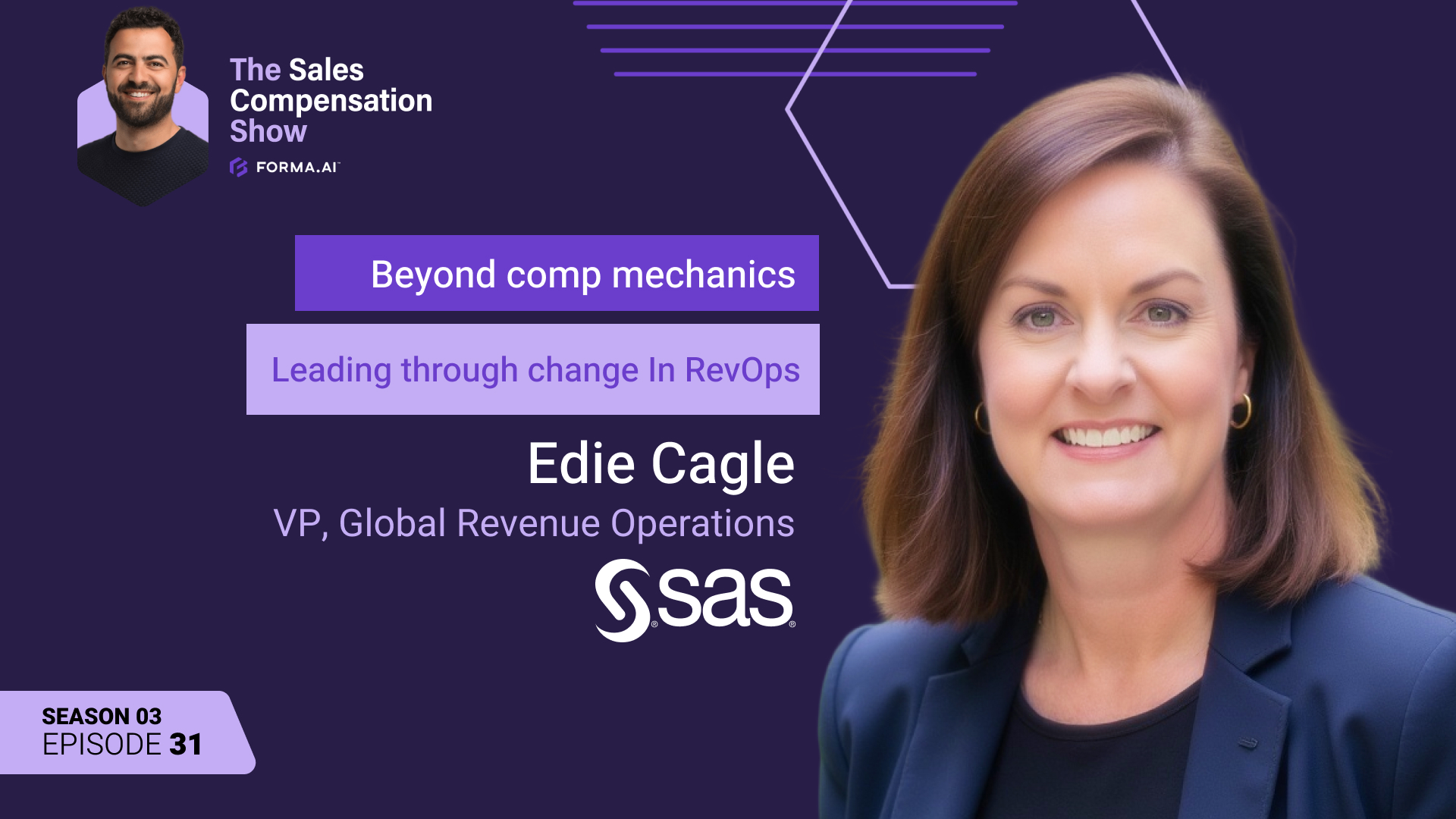
How SAS approaches RevOps change, trust, and global sales compensation strategy
How SAS approaches RevOps change, trust, and global sales compensation strategy
Learn how the VP of Global Revenue Operations at SAS approaches change fatigue, incentive governance, and global sales compensation strategy.


How SAS approaches RevOps change, trust, and global sales compensation strategy
Learn how the VP of Global Revenue Operations at SAS approaches change fatigue, incentive governance, and global sales compensation strategy.
How SAS approaches RevOps change, trust, and global sales compensation strategy
Learn how the VP of Global Revenue Operations at SAS approaches change fatigue, incentive governance, and global sales compensation strategy.
How SAS approaches RevOps change, trust, and global sales compensation strategy
Learn how the VP of Global Revenue Operations at SAS approaches change fatigue, incentive governance, and global sales compensation strategy.
Global RevOps leadership gets difficult fast when the business asks for several things at once.
You're tasked with accelerating teams, staying aligned, creating consistency, supporting the field, and keeping compensation driving the right outcomes.
All simple on the surface, but rarely in practice.
This tension is what we explore in the latest episode of The Sales Compensation Show.
In her conversation with Forma.ai CEO and founder Nabeil Alazzam, Edie Cagle, VP, Global Revenue Operations at SAS, shares what goes into the harder leadership questions underneath compensation mechanics. Including where governance needs to stay firm, when incentives are being asked to do too much, and what global consistency should really look like.
What makes this episode particularly great is Edie's breadth of perspective. Starting in software development, she spent over a decade helping build SAS’s internally developed CRM, then moved to lead on the business side.
Since then, Edie's shaped global incentive strategy and seen firsthand how compensation changes when ownership and decision-making move across functions.
If your world involves go-to-market shifts and the constant pressure to operationalize change (often faster than the business can comfortably absorb it), this conversation will feel particularly relevant.
Below, browse the biggest ideas from the discussion, and be sure to listen in on Spotify, Apple Podcasts, and YouTube.
Episode resources
- Connect with Edie on LinkedIn
- Edie's recommended book: The Culture Map by Erin Meyer
Sales incentives can't rescue a weak go-to-market strategy
One of Edie's greatest takeaways (something every compensation professional will nod along with) comes early in the episode: sales incentives will not fix a broken strategy.
If the product lacks a real go-to-market strategy, the coverage model is wrong, pricing is off, or the wrong sellers are carrying the motion, sales compensation cannot make up for these issues.
At best, it may create a short burst of activity, but not durable success.
Too many organizations still treat comp as the first lever to pull when a problem rears its head. New product struggling? Add an incentive. Need a new behavior? Add a measure. Want faster adoption? Pay more for it.
Edie argues this instinct skips the most important questions:
- Where exactly are we selling this?
- Who's supposed to sell it?
- What's the expected revenue outcome?
- What behavior are we specifically trying to create?
- Is the underlying motion set up to succeed?
Earlier in her career, Edie admits she might have scrambled to find a compensation solution, but now she pushes back until the strategy's clear.
Ultimately, the best compensation leaders are strategic filters. You have to protect the business from using pay as a patch for upstream problems.
So when a request for a new incentive rolls in, don't instinctively jump to model the payout curve. Instead heed Edie's advice and interrogate whether the business has earned the right to add incentive design on top of a well thought-out motion.
It's easy to underestimate the operational weight of change
Early in the episode, Edie also articulates that change itself is often vastly underestimated.
While strategic decisions can look clean from the outside, once they hit operations the amount of work required from RevOps to make them real is significant.
And yet, senior leaders often talk about transformation as though the hard part is making the decision. The difficult part is actually anticipating and absorbing downstream effects of layered initiatives.
When there’s inevitable fatigue around frequent changes, sellers can even start questioning rules that didn't change. Managers end up losing confidence in what to reinforce in this situation, and then ops teams become part project office, part translator, and part emotional shock absorber.
Ultimately, if you're aiming to change multiple things simultaneously, the business can pay for confusion twice: once in operational load, and again in lost productivity.
Edie’s view is that change should be scoped in terms of organizational absorbency (vs strategic importance alone).
This means asking tougher questions up front, like:
- How many simultaneous changes can this organization realistically process?
- Where will confusion appear first?
- What support mechanisms need to exist after rollout, not just before it?
To address uncertainty in the org in real time, Edie shared SAS hosts live Q&A sessions during major change periods Their RevOps team intentionally builds this listening and clarification mechanism into the rollout at multiple points.
The broader takeaway here is that change management isn't adjacent to revenue performance. It is a baseline requirement for it.
RevOps influence is not built on data alone
When Nabeil asks what RevOps often gets wrong about influence, Edie shares the function can lean too heavily on data and analytics.
But, as she put it, the data alone is incomplete.
To influence the field effectively, RevOps also needs to understand how sellers work in reality, how managers interpret change, and what the front line expereinces that systems don't fully capture.
It's easy to sometimes mistake precision in your analysis for credibility, but frontline trust is rarely built this way alone. Your recommendations need to reflect both evidence and operating reality (likely coming from the field).
Edie recognizes that effective RevOps requires marrying science and art. And this has real implications for plan design and rollout. If you rely only on structured data, you're more likely to miss the nuance that shapes seller behavior in practice.
As you establish RevOps influence, use data to identify patterns first, then use field input to deeply understand the cause. Only then can you earn trust to make your subsequent recommendation land.
Good governance needs both backbone and empathy
When the conversation turned to governance, Edie was adamant strong compensation governance requires firmness and flexibility.
Without policies, exceptions multiply and the plan becomes easier to manipulate. But Edie's equally clear that governance without empathy is no good.
For example, when an account transitions from one AE to another, SAS has a policy to reevaluate the target of the AE receiving the account. In most cases, this makes sense. But sometimes the surrounding circumstances override this. Economic conditions, regional realities, or other uncontrollable factors can make a rigid application of the rule less fair.
The answer to this challenge is to build a framework that can handle edge cases without losing its shape.
Edie explains that SAS supports this flexibility as needed with structured workflows for qualitative feedback and escalation. Compensation and operations review these situations routinely, and more complex cases can move up the sales chain to the CSO.
This ends up creating room for judgment without turning exception handling into improv.
As Edie and Nabeil agree, fairness isn't about treating every situation the same. But insteadhaving a principled way to decide when variance is warranted. It's not always about drawing harder lines.
Where compensation in the org sits shapes how it works
When Nabeil asks Edie about the experiences that have shaped her point of view, she happens to land on a question that comes up a lot in sales compensation circles:
where should comp sit, and what happens when it sits in the wrong place?
Her answer is grounded in SAS’s own evolution. Over time, compensation ownership shifted through several models, and each one produced something meaningfully different in practice.
Initially, SAS ran decentralized incentive plans. Different countries and regions were rewarding different things. Some prioritized specific products. Others emphasized new revenue or renewals. Eventually, SAS centralized that model into a single global incentive strategy with a dedicated team.
But centralization alone did not solve the problem. As Edie explains, the next shift changed the strategy in a different way.
Compensation later moved under Finance. But at this point, it started functioning less as an incentive mechanism and more as a cost-containment measure. This only led to disengagement and behavioral issues (an important reminder that compensation design is never neutral just because the math is sound).
Today, in a more balanced structure, compensation reports into the COO, with a committee that includes the CFO, CHRO, and CSO. This model means that rather than one function optimizing for its own priorities, leaders have to work through the trade-offs together.
For Edie, effectively: location matters less than collaborative alignment.
It means the question you should ask is not simply whether comp should sit in Sales, Finance, HR, or Operations—it's whether the structure produces balanced (or distorted) decisions.
When comp is too isolated inside one function, it can become narrow and overly sales-led, finance-led, or administrative.
Ultimately Edie urges leaders not just to ask who owns comp, but instead whether your operating model brings the right cross-functional perspectives into the room early enough to shape the plan well.
That is often a better predictor of plan quality than org chart placement alone.
Global consistency still needs local reality
Edie closes with an important lesson from SAS’s global compensation evolution: culture changes how a plan lands.
That is where many centralization efforts get into trouble.
While standardization brings real benefits (cleaner admin, stronger governance, better visibility), when global consistency turns into cultural blindness, friction follows quickly.
Edie points to a few practical examples:
- in some APAC environments, decision-making is more hierarchical. In the U.S., sellers may operate more independently.
- In parts of EMEA, extended summer time off can shape both targeting and compensation assumptions.
These differences directly affect how plans are interpreted and how sellers behave.
The point is that global frameworks work best when they distinguish between what should stay consistent and what needs room to vary locally.
Want more insights like this? Subscribe to The Sales Compensation Show on Spotify or Apple Podcasts, or YouTube for bi-weekly episodes featuring the revenue leaders behind today’s fastest-growing companies.
.jpg)
.jpg)
.jpg)


