.png)
Your CRO doesn’t need another dashboard (they need RevOps to run the revenue engine)
Your CRO doesn’t need another dashboard (they need RevOps to run the revenue engine)
If RevOps shows up with “reporting,” you’ll lose influence. Learn what CROs expect in 2026—and how to deliver it with AI and rigor.


Your CRO doesn’t need another dashboard (they need RevOps to run the revenue engine)
If RevOps shows up with “reporting,” you’ll lose influence. Learn what CROs expect in 2026—and how to deliver it with AI and rigor.
Your CRO doesn’t need another dashboard (they need RevOps to run the revenue engine)
If RevOps shows up with “reporting,” you’ll lose influence. Learn what CROs expect in 2026—and how to deliver it with AI and rigor.
Your CRO doesn’t need another dashboard (they need RevOps to run the revenue engine)
If RevOps shows up with “reporting,” you’ll lose influence. Learn what CROs expect in 2026—and how to deliver it with AI and rigor.
When the market changes as fast as we've come to expect today, the standard definition of “doing your job” stops being enough.
RevOps is in this moment right now.
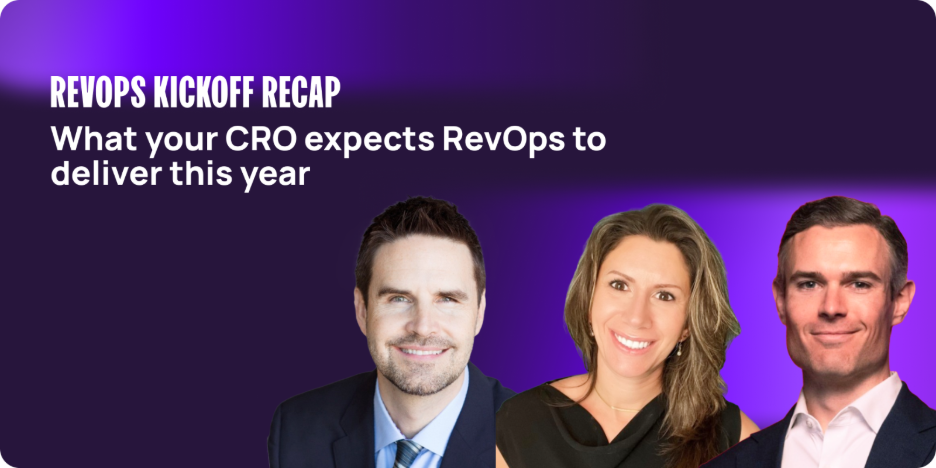
So at RevOps Kickoff 2026, we assembled a panel of elite revenue leaders to get candid about what CROs actually expect from this function in the coming year. We heard from James Roth (CRO at ZoomInfo), Jeff Ford (CRO at Trimble), and Maia Josebachvili (the CRO of Stripe’s AI business).
And our guests didn’t sugarcoat the “moment” we're in. As they reported, software has become harder to sell, rep attainment has compressed, and “predictable growth” requires even sharper decisions.
All the while, AI is flooding the go-to-market stack with new capabilities and chaos. While everyone in the org has access to more info than ever, CROs are still staring down the same brutal question at the end of every week: what’s real, what’s noise, and what do we actually do next?
Which is why RevOps leaders showing up with mere “reporting and enablement” isn’t going to cut it this year.
Read on for how Maia, Jeff, and James recommend building more growth and accountability into your rhythms of business, and be sure to grab the session replay to send your team.

1) Stop “supporting sales.” Start operating the revenue engine instead.
If there’s one message that set the tone for this session, it’s that RevOps can’t win 2026 by functioning as a high-output service desk. Targets are aggressive. Buying has gotten harder. AI is speeding up how quickly the go-to-market machine can change, and how quickly it’s expected to respond.
This current context is why Nabeil Alazzam (CEO of Forma.ai) framed RevOps as the “COO of the business organization.” Maia agreed immediately. CROs need RevOps to keep the revenue engine aligned and compounding, not simply well-documented.
At Stripe, Maia described RevOps being “right in there” with growth because their customers are scaling in a way traditional SaaS teams rarely plan for. As she shared, the median AI company Stripe sees is slated to be operating in 79 countries by year two. This kind of velocity breaks comfortable assumptions around enablement, capacity planning, segmentation, and where expansion really comes from.
So what changes in practical terms? Well, instead of measuring RevOps by volume of outputs, CROs will be evaluating whether RevOps is improving the business outcomes that make growth predictable. For example:
- Forecast reliability: Are leaders surprised less often?
- Conversion health: Is pipeline turning into revenue in the segments that matter?
- Time-to-value: Are customers reaching value fast enough to renew and expand?
- Cross-functional clarity: Are marketing, sales, CS, and product rowing in the same direction?
This is what “operating the revenue engine” looks like. It’s leverage and fewer blind spots.
And the fastest way to step into this posture isn’t another round of meetings or a rebuilt dashboard library. It's to start with a constraint. Pick just one part of the engine where a meaningful improvement changes the company’s ability to hit the number.
Ask the question most teams avoid because it forces tradeoffs: What is the single biggest constraint preventing predictable growth right now?
Here you'll want to aim for something you can operate, not a vague symptom. Examples include conversion in a core segment, speed of global expansion, churn in a specific cohort, ramp time, deal cycle length, or a capacity mismatch.
From there, run RevOps like a product team would:
- Define the outcome in business terms. What changes, for whom, and by when?
- Build an operating rhythm that ends in decisions. Updates are cheap. Actions are the point, so make these clear.
- Treat cross-functional alignment as part of the deliverable. Growth rarely fails because one team tried too little. It fails because teams pull in different directions.
If you execute against this North Star well, reporting and your dashboards naturally end up in the right place. Reporting becomes evidence of a well-run system, not the system itself.
2) Become your CRO’s source of truth and accountability partner.
So operating the revenue engine sounds inspiring, sure. But it also gets real the moment the quarter gets tight. That’s when every leader has a story, every deal “feels close,” and the forecast starts to drift. This is where RevOps needs to protect reality and force clarity according to our experts.
As James shared, CROs are paid to be persuasive. But they're also human, which can lead to decision-making that drifts from evidence toward conviction at times. So RevOps has to become the counterweight. An “unbiased commitment to the truth,” in James' words.
On this, James described a shift he has pushed inside ZoomInfo: he now expects sales leaders to forecast their own business. If you cannot (because you lack the right dashboards or rhythms), then you aren't leading. This new expectation clears the space for RevOps to stop babysitting hygiene and start improving the underlying engine.
In other words, James wants RevOps working upstream. Refining signals, spotting patterns by vertical or segment, and turning observations (i.e.: “these three things happened”) into sales actions like “reach out now, and say this.” Further, he's asking RevOps to lean into using AI to compress the cycle time, because what used to take a year and a hundred sprints can now get shipped into workflows far faster.
Maia took this idea one step further. She wants RevOps to raise the standard of how the business runs. Which includes accountability in the moment, especially in forecast calls:
In a forecast review, a strong RevOps leader doesn't just nod and capture the number. They ask questions forcing clarity:
- What is the champion’s motivation?
- What changed to justify our confidence here?
- Why does this forecast assume a conversion rate above what we have seen historically?
These types of questions ultimately teach teams what “good” looks like. Over time, the accountability reduces the politics and prioritizes evidence.
Maia’s “trifecta” is a useful way to define the RevOps job at the senior level, too. You're looking for your top RevOps person to be:
- The source of truth: they define and get the metrics people trust, even when they are inconvenient
- An arbiter: This person's the interpretation that stays grounded in data rather than narrative
- Your accountability partner: This is the person who keeps the process honest and decision-ready
A practical way to apply this without turning RevOps into the pipeline police is to ensure you make rigor feel like the system, not the personality.
For this, set a standard set of challenge prompts for forecast and pipeline reviews. Instrument stage movement so it's tied to verifiable customer outcomes. And use automation and conversation intelligence to reduce arguments about hygiene. When the evidence is built into the workflow the team expects, coaching gets easier and forecast calls get faster.
One more nuance from the broader panel is worth keeping in your back pocket. RevOps loses influence the moment rigor starts to feel like enforcement. The goal is clean truth that leads to clean action. Teams will accept hard questions when they can tell you're trying to help them win the quarter, not catch them in a mistake.
3) The essential RevOps skill in 2026 is curiosity (and the courage to keep learning).
A well-run engine with tightened execution can only work if RevOps can keep pace with change.
So when Nabeil asked what skills to prioritize for RevOps leaders today, James went straight to the characteristic separating operators who can scale from those who get stuck:
As James points out, companies often love to hire someone from a great company they've heard of and assume excellence transfers automatically.
But context matters. So does product-market fit. Most of all, the mindset you bring with you matters.
If a candidate’s greatest asset is “this is how we did it at Oracle” or “this is how Salesforce runs AE Home,” James warns, you’ll get replication, not adaptation.
What he wants instead is a learning engine in human form. Someone who shows up saying: “I talked to peers. I went to a RevOps event. I saw three interesting approaches. We should test them.” That energy is operational leverage.
James also shared that curiosity has to pair with horsepower. He called out the need for highly analytical thinkers, especially in strategy and analytics, because the job is not just spotting ideas. The job is filtering signal from noise, then translating insights into workflows the field actually uses.
So what you should do differently this year?
Make learning a visible input to your operating cadence. Curiosity dies when it's forced to become a side hobby, so give it a place to live. A monthly “what we learned” block works well. Think peer conversations, competitor moves, customer patterns, new tooling, pricing shifts. The point is relevance and application (not volume).
Ultimately, RevOps leaders who build a learning system will earn trust faster. These leaders show up with options, data, and recommendations, not opinions. Over time, they become the person a CRO calls because they are the one adapting while everyone else is busy defending the old playbook.
4) Pricing and packaging are RevOps territory now (especially in a usage-based world)
If curiosity is the skill to focus on, this is one of the places it pays off fast...
Maia pointed to a shift that is already forcing new operating models across AI-heavy businesses: pricing is moving from clean subscription logic to usage-based or hybrid models.
SaaS has largely experienced a time when marginal cost was close to zero. Add a seat, collect the subscription, move on. But AI doesn't work that way.
As Maia says, many fast-scaling AI companies start with straightforward subscriptions, but then move toward usage-based billing as the product and cost structure evolve. The bigger message here is the operational consequence. Usage introduces variability. And variability breaks a lot of planning muscle memory RevOps is used to.
Once revenue is tied to consumption, several things get harder at the same time:
- Quotas can’t be set off static seat counts.
- Incentives can’t blindly reward “bookings” if expansion is consumption-driven.
- Forecasting needs leading indicators (product usage signals), not just pipeline stages.
Which is why Maia wants RevOps “in there with [the CRO],” modeling the messier reality. CROs will still ask for predictability amid this messiness, so RevOps has to manufacture it from new inputs. So this year, focus on building a model that respects variability, and work to protect margin with with guardrails. As a RevOps leader, get ahead of usage-based pricing solutioning as early as you can.
5) Don't frame AI as tool rollout. It’s a productivity strategy (and a governance problem)
AI comes up in every revenue conversation right now. And our speaker Jeff Ford covered a lot of ground here.
He started with the uncomfortable truth: software's been harder to sell for the last three to four years. The old, fairly predictable bell curve of attainment has changed shape:
And now, your CFO faces a fair question. Why fund more headcount when the current capacity is under-producing? As Jeff shares, until attainment starts looking more like 70–80% of reps hitting plan, the business case for scaling is harder to win.
This is where you'll want to stop using “tool rollout” language when it comes to framing your AI bets. Your company is looking for a sales productivity plan.
This year, RevOps has to put on a financial hat alongside the CRO and make choices that raise output per rep. AI can certainly help, but only if it gets translated into workflow, adoption, and measurable lift.
Jeff also flagged that as agents and automations multiply, sellers will face a noisy landscape mid-year. Some tools will be legitimately transformative, whereas others will be poorly suited to how sales actually works. Enablement becomes the filter here, so plan accordingly!
A practical way to run AI in 2026 is to treat it like any other productivity initiative: a small number of bets with clear metrics, and disciplined rollout.
- Pick a few outcomes that matter to the CFO and CRO. Think ramp time, cycle time, meetings-to-opps conversion, win rate in a priority segment, time spent on non-selling work.
- Tie each outcome to one workflow change. Not a vendor. A behavior change. What does the rep do differently on Tuesday?
- Make enablement the navigation layer. Sellers need a short list of “approved plays,” quick training, and guardrails. They also need permission to ignore noise.
- Report impact like a business case. Baseline, pilot, adoption, lift. Then scale what works.
AI will not earn trust because it sounds modern. It earns trust when it shows up in attainment, efficiency, and a forecast the CFO can believe.
What CROs really want from RevOps in 2026
After all the debate about org design, tools, and AI, the CRO expectation is still surprisingly crisp. RevOps has to make reality usable.
This means doing two jobs at once. First, bring clarity. You need to provide unbiased data, clean definitions, and leading indicators that hold up when the quarter gets noisy. Then convert this clarity into movement. Get your wider team making better calls with faster adjustments, and ensure higher productivity. The overall goal is more predictable growth.
The panel also hinted at the RevOps role expanding toward general management. Jeff’s path from RevOps leadership into a CRO seat is not an outlier. It’s a preview of where the function is headed when companies need operators who can run the system, not just report on it.
So if you lead RevOps or sales compensation in 2026, think about the job you're really being hired to do. I.e. Building a learning engine and bringing your CRO options backed by evidence.
At. theend of the day, reports still matter. They just can’t be the entire value.
—
Want the full discussion on-demand? Grab the full session replay from RevOps Kickoff 2026 and share it with your revenue leadership team.
.jpg)
.jpg)
.jpg)


