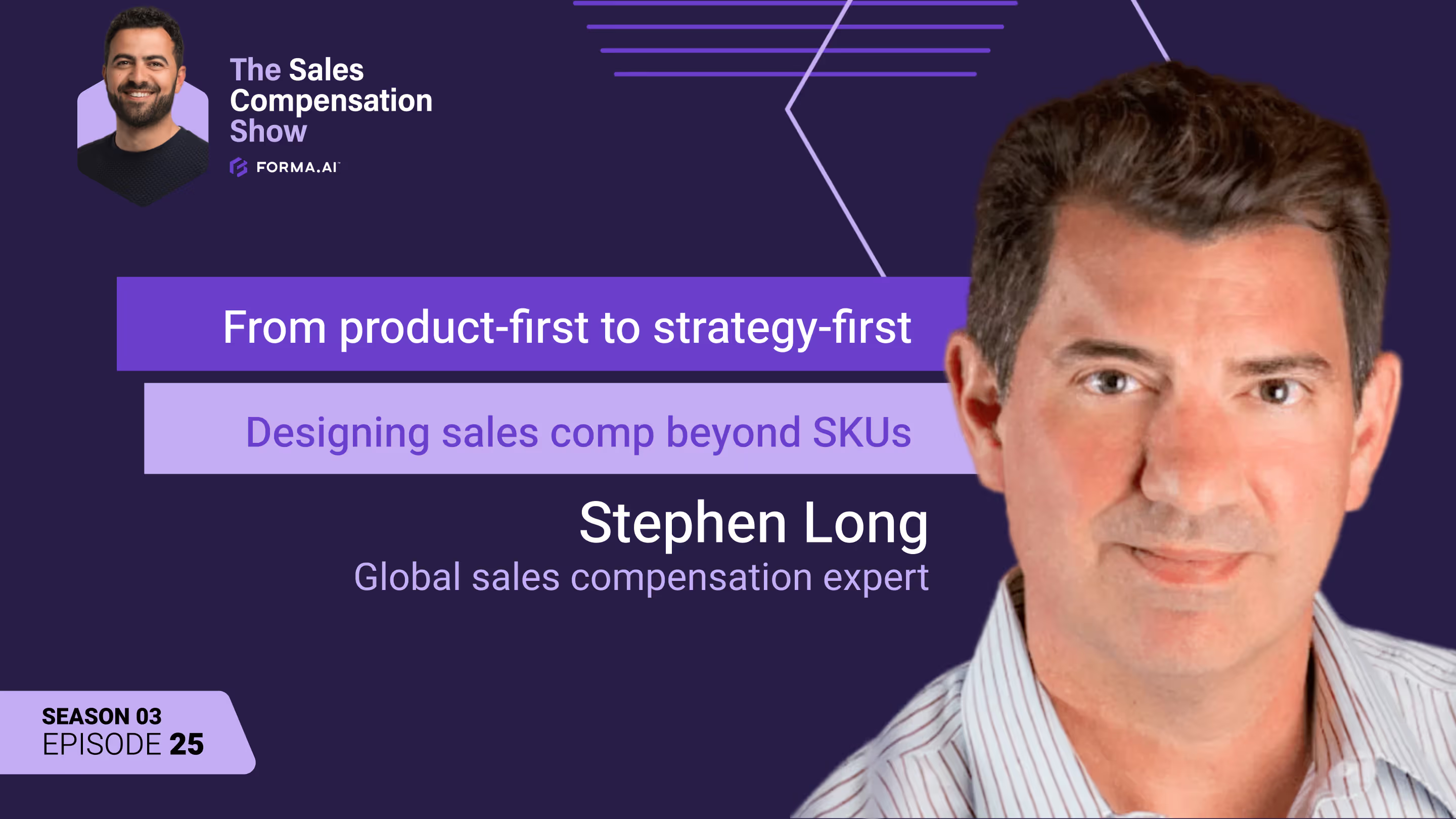
Stephen Long on designing sales comp serving strategy, not SKUs
Stephen Long on designing sales comp serving strategy, not SKUs
Global sales compensation expert Stephen Long shares how to align sales comp with strategy, fix quotas, and prevent plan gaming for healthier growth.


Stephen Long on designing sales comp serving strategy, not SKUs
Global sales compensation expert Stephen Long shares how to align sales comp with strategy, fix quotas, and prevent plan gaming for healthier growth.
Stephen Long on designing sales comp serving strategy, not SKUs
Global sales compensation expert Stephen Long shares how to align sales comp with strategy, fix quotas, and prevent plan gaming for healthier growth.
Stephen Long on designing sales comp serving strategy, not SKUs
Global sales compensation expert Stephen Long shares how to align sales comp with strategy, fix quotas, and prevent plan gaming for healthier growth.
There comes a point where sales compensation strategy stops being theoretical and starts costing real money.
At this point—once rubber hits the road—if your goals are unclear, data's half-baked, or quotas are pushed through on gut feel, the damage shows up in spades.
You'll start to notice distrust, quiet gaming, and a salesforce that learns to sidestep around the plan instead of working with it.
Stephen Long has spent decades in this tension as a global sales compensation leader. In this episode of The Sales Compensation Show podcast, he joined Forma.ai CEO Nabeil Alazzam to talk about the judgment calls behind typical plan mechanics. Foundational aspects of compensation, like:
- identifying your desired end state,
- pushing executives toward a 3–5 year horizon to achieve this ideal end state via solid data infrastructure, and
- refusing to bolt incentives onto infrastructure that isn’t ready.
The conversation jumps between strategy and operations—from strategy decks and CRM fields, to quota models and field politics. What emerges is a practical lens for senior leaders who want to stop running annual fire drills and build growth instead.
We’ve pulled out the big ideas and paired them with short clips in the recap below. For the whole episode, tune in on Spotify, Apple Podcasts, or YouTube.
Episode resources
- Connect with Stephen—a founding member of our Sales Comp Think Tank — on LinkedIn
- Episode book recommendations: Sales Compensation Essentials: A Field Guide for the HR Professional, By S. Scott Sands, Jerome A. Colletti, Mary S. Fiss, et al. and Compensating New Sales Roles: How to Design Rewards That Work in Today's Selling Environment by by Jerome A. Colletti, Mary S. Fiss
Stephen's core advice? Begin with your ideal end state, not the product/flavor of the month
Stephen’s biggest “plan design” red flag is simple: Senior leaders often don’t define the real end goal clearly enough.
They’ll say, “We need to push Product X,” then over-rotate to pay more on a few focus products.
What typically happens in this scenario is that reps sell the focus products aggressively, for a time, but the company can still miss its overall revenue or margin goals.
Unfortunately, in this case, many times the plan has actually done exactly what it was intended to do—but not what the business actually needed. And that mistake starts with your overarching strategy.
Here's Stephen on this challenge he's seen play out consistently:
To overcome this challenge senior compensation leaders need to slow the room down and force precision. Ahead of a focus on one SKU or another, Stephen encourages to go broader. Get clear on the overarching strategy by asking pointed questions like:
- Are we optimizing for total revenue, margin, product mix, contract health, or market share?
- Is the goal to grow this product line at all costs, or to hit this year’s number via healthier mix?
- If we pay more for Product X, what are we willing to pay less for?
The strategic opportunity for you in these early conversations is to:
- Turn vague priorities into explicit, ranked objectives,
- Push back on never-ending “and” goals (“Grow revenue and margin and new products and retention”), and
- Get the CRO and CFO to sign off on a primary outcome your plan will be built to drive.
As Stephen shared, once you have this, you’re no longer simply “making the plan work", but instead you're designing a behavior engine tuned to the real business target.
Build the data infrastructure before you put money behind a plan design
Stephen called out another common failure pattern in this episode. It goes like this:
- Leadership falls in love with a new product or metric.
- They insist it must be in next year’s plan.
- Sales comp and ops say, “We can’t track this cleanly yet.”
- Leadership says, “We’ll get you a manual report.”
- Reps get paid off opaque, lagging, error-prone data.
- Shadow accounting and disputes explode. Reps get discouraged and stop selling the product that was intended as the focus.
He talks about this here:
In cases like this, Stephen says you'll want to shift the horizon for the conversation to a 3–5 year view. In other words, your playbook as a comp leader can be to:
Request the multi-year strategy, not just the next-year wish list:
- Aim to understand exactly what’s launching in years 2–3,
- Determine which product lines are slated to matter most in three years (not just one that's hot right now).
Co-build a roadmap with Sales Ops, IT, and CRM:
- Year 1: Use SPIFFs and simple metrics on what you can track reliably.
- Year 2: Stand up the data pipelines, validations, and field-facing reporting.
- Year 3: Promote those measures into core plan metrics, now that reps can see them in real time.
Phase-change your incentives as your data becomes more sophistcated. For example:
- Phase 1: “We’ll reward early adopters through a contest.”
- Phase 2: “Now it’s in your variable compensation, but with heavier enablement and controls.”
- Phase 3: “This is now a core metric with robust reporting and automation behind it.”
The point here is beyond thinking longterm. It's that comp plans should be the final expression of a system that already exists, not the first place a half-baked idea appears.
Treat quotas like an internal product (and walkthrough the logic behind the number)
When new plans roll out, Stephen points out that reps care about one thing first: “What’s the number I have to hit?”
In fact, they’ll often ignore or delay plan acknowledgments until they see quota. And as such, many compensation plan complaints are actually quota complaints in disguise.
In this clip, Stephen dives into the reality though; if the company’s number goes up, sales quotas have to go up. But, as he shares, the difference between an angry field and a bought-in one is methodology transparency.
In complex organizations, variables and logic multiply fast. So if you don’t tell the story of your quota model, the field will write its own story, and it usually starts with, “They raised quotas just to pay us less.”
Your job is to preempt this narrative with evidence and clarity.
If you end up with reps at 6%, 8%, 10% growth targets—you need backing for each one.
So think of quota setting just as you would an internal product you launch:
- Document the methodology. Even if it’s simple, write it down.
- Simulate and test i: i.e. How would last year’s performance have looked under this year’s constraints?
- Create quota explanation packets or deck slides re: “Here’s how we got from your last year’s number to this year’s goal.”
- Collect and use data as feedback: Are pockets of the org consistently under 80% sales attainment? That’s a capacity or potential question, not a motivation problem.
Translate plan attributes for reps – and design for gaming, not ignorance
As orgs scale, plan surfaces get more complex. There are more crediting rules, contracts with multiple attached products, partial credit scenarios, and contract health criteria (terms, margin, product mix.
And as this complexity dials up, reps rarely struggle with the math. The struggle with what counts, when, and why. Here's Stephen's take:
If they don’t understand that:
- Product A with Attachment B pays 70% credit
- Product A alone pays 100%
- Product A with Attachments B and C at zero price quietly erodes margin
…you’ll either get unintentional mistakes or very intentional gaming.
Stephen shared an example. In one org, where reps were paid heavily on year-over-year contract value growth, they also had a lot of pricing autonomy. This meant they loaded contracts with “attached” products, deeply discounted, and collected bigger payouts based on growth that wasn’t profitable or durable.
To counter this, Stephen helped redesign the comp plan to focus on contract attributes, not just top line. He reduced weight on pure contract value, and added payout components for:
- Payment terms within defined thresholds,
- Inclusion of strategic new product lines, and
- Other indicators of contract “health”.
And crucially, they ensured that if a rep sold the kind of contracts the business wanted, they would make more, not less, than under the old structure. Here's how you should think about this takeaway for your own org:
Translate plan attributes in rep language:
- “If you structure the deal like this, you’ll earn roughly that.”
- Show side-by-side examples of “old behavior vs. new behavior” and resulting payouts.
Assume gaming and harness it:
- Identify the levers reps can realistically pull (discounts, term length, attach rates).
- Align payout logic with what’s profitable and strategic, not just what’s easy to sell.
Use useful enablement to lock it in:
- Think deal calculators, not just PPTs.
- Real contract examples, not hypothetical ones.
- Live Q&A sessions where reps test “what if I do this?” scenarios.
If reps understand the attributes that matter and see that “doing it right” pays more, you’ve turned potential gaming into aligned optimization.
Go from plan mechanics to strategic Influence
Stephen Long’s conversation with Nabeil is a reminder that sales compensation is absolutely a strategic discipline, not a back-office function.
If you’re a senior Sales Comp, RevOps, or Sales Ops leader, your leverage comes from moving beyond “are we paying correctly?” to:
- What is the real outcome this plan is designed to drive?
- Do we have the infrastructure to support it for the next 3–5 years?
- Can every rep understand how behavior → credit → cash?
- Have we anticipated gaming and turned it into a feature, not a bug?
- Can we defend our quota logic to the field and the CFO with the same confidence?
After listening to the clips and full episode above, consider:
“If we applied this thinking to our next planning cycle, what would we change first?”
And if you want to go deeper into integrating territories, quotas, and incentives into a single, agile SPM strategy, you can find the full episode of The Sales Compensation Show on Spotify, Apple, and YouTube.
.jpg)


