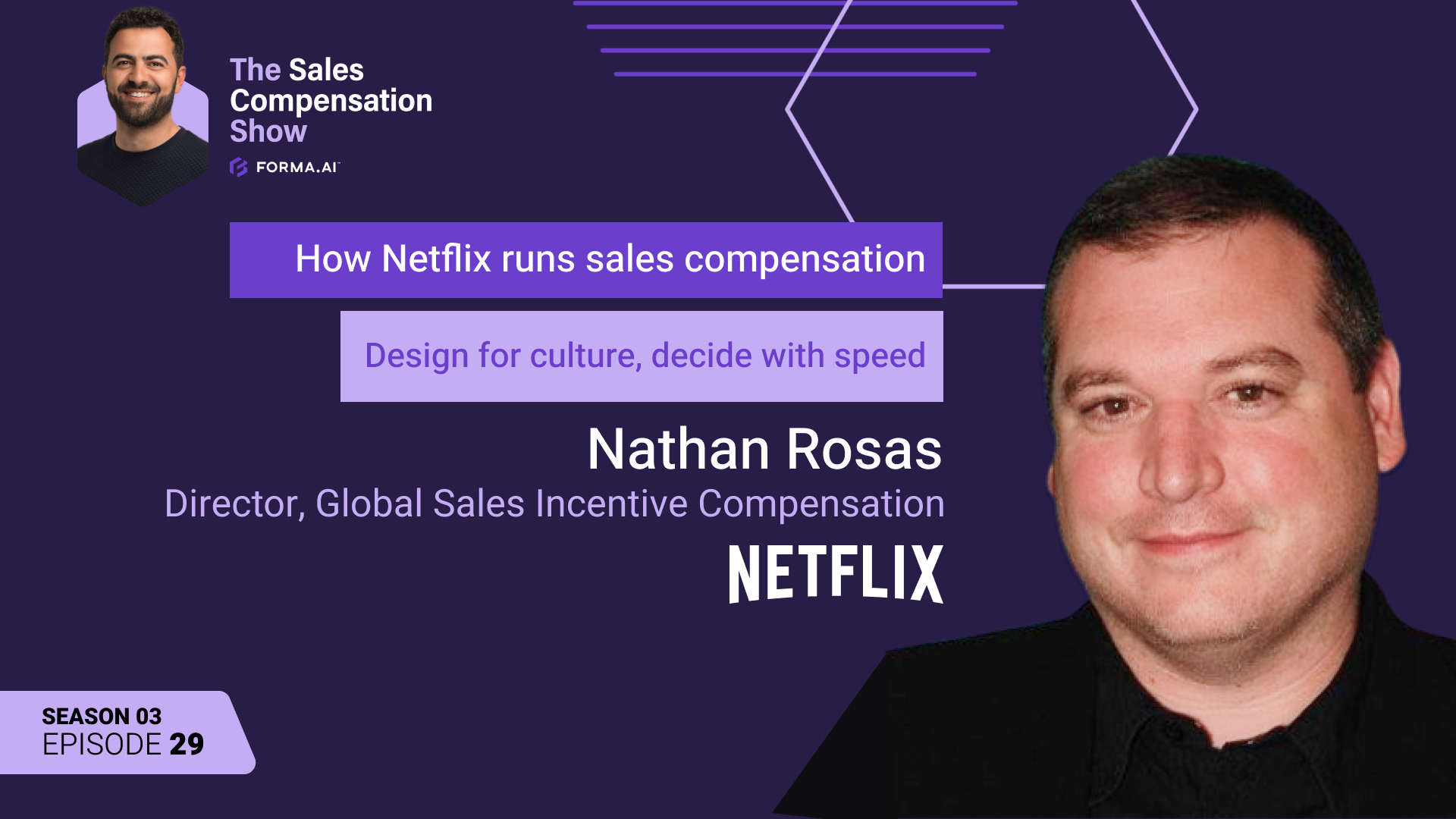
How Netflix runs sales compensation: Designing for culture, deciding with speed
How Netflix runs sales compensation: Designing for culture, deciding with speed
Netflix’s sales compensation leader shares how to design incentives for changing environments and scaling simple plans that still feel tailored.


How Netflix runs sales compensation: Designing for culture, deciding with speed
Netflix’s sales compensation leader shares how to design incentives for changing environments and scaling simple plans that still feel tailored.
How Netflix runs sales compensation: Designing for culture, deciding with speed
Netflix’s sales compensation leader shares how to design incentives for changing environments and scaling simple plans that still feel tailored.
How Netflix runs sales compensation: Designing for culture, deciding with speed
Netflix’s sales compensation leader shares how to design incentives for changing environments and scaling simple plans that still feel tailored.
On the surface, Netflix is an entertainment company you likely know for its original, binge-worthy hits gracing your television. But most people never get to see the inner workings of this high-performance organization.
So we're taking you behind the sceens with Nathan Rosas, Director of Global Sales Incentive Compensation at Netflix to understand how he thinks about motivating their sellers and how he intentionally keeps incentive programs simple while the Netflix ad business evolves.
Nathan has built incentives programs across Microsoft, Amazon, and now, at, Netflix he's ensuring the comp function enables speed and provides a ton of context where the ads business is experiences constant change.
In this chat, hear how Nathan prioritizes simple plan mechanics that can keep pace with these persistent shifts, plus the one core operating principle that he's been most pleasantly surprised by at Netflix.
We've curated our favourite takeaways in what follows. Catch the full episode on Spotify, Apple Podcasts, and below on YouTube.
Episode resources
- Connect with Nathan, a founding member of our Sales Comp Think Tank and one of the Top 50 Sales Comp Leaders of 2026 on LinkedIn
- Book recommendation: Go Put Your Strengths to Work by Marcus Buckingham
You can't rely on playbooks. Design incentives tailored to your unique organization
Similar to Nathan, if you’ve built incentive plans across multiple organizations, you’ve probably found that the mechanics that were “bulletproof” in one company can feel oddly fragile in another.
You can have the same job title and exact same revenue goal. And yet? Completely different expectations from sellers, leaders, and the business.
Given he's moved through very different operating environments, Nathan recommends rooting your strategy in a lived reality. You just can't transplant a plan that worked somewhere else and assume it will work in a new place:
You need to adapt to your current environment or constraints. Nathan's seen how incentive programs succeed best when they’re shaped to the company’s innate culture.
As he shares, in one environment, a large, structured incentives operation is exactly what the business needs: lots of plans, lots of stakeholder inputs, lots of support required to make the rep experience seamless. In another place, however, the best version of sales comp can be the opposite—a lean, low-touch program prioritizing clarity and speed over process density. Neither's “better.” They’re simply responses to what the company is optimized for.
The most useful shift for senior comp leaders is to stop treating culture as background context and start treating it like a design input. Because the plan signals how the organization expects work to happen: how much autonomy sellers have, how fast decisions move, how much operational friction is tolerated, and how performance gets discussed.
So before you debate quota methodology or accelerators, it’s worth asking a more foundational set of questions:
- What does this company reward in practice—precision or pace?
- Does the sales org expect high-touch support or self-serve clarity?
- Is the culture built for stability or iteration?
Once these answers are clear, the downstream choices get easier. Complexity stops being a philosophical argument and becomes a practical one: what can we operationalize cleanly here—and what will quietly slow us down?
It's fine to bring your playbooks and design principles with you, of course, but let the company's environment and unique needs determine the shape of the program you'll build.
Catch misalignment before it hits revenue with listening mechanisms
Designing for an org's unique culture is step one. Step two is harder: making sure the plan lands the way you think it lands, in the hands of managers and in the daily reality of reps.
A comp plan can be perfectly designed and still underperform because it's not clear for the sellers. Not necessarily in the decks or in leadership alignment. But in the messy middle where managers translate the message.
Nathan frames this more as a discipline versus a “support function.” Because leadership direction is just one lens. The manager lens is different. The rep lens is different. And the delta is often where motivation quietly drifts off course.
While Nathan acknowledges the top of the org will always have the heaviest vote on plans, he's saying your plan succeeds or fails based on how this gets perspective is interpreted downstream. For this, managers are the messengers and the amplifiers. Reps are the reality check.
When you listen across levels, you’re measuring whether the motivation you’re creating matches the outcome you’re trying to create. It’s about reducing the probability of spending two quarters “diagnosing” what you could have heard in week two.
Here's a few things you can do as a senior comp leader to ensure you're hearing friction before it has a time to show up in your revenue results:
- Treat manager and rep touch points as your sensors. Office hours, rollout Q&A, manager enablement, skip-level patterns are all critical instruments. They tell you instantly where a message is breaking.
- Listen for translation errors. What leaders intend, what managers repeat, and what reps believe are often three different things. Isolate this gap as it's where friction and unintended behavior begins.
- Use qualitative insight to sharpen your decisions. Data will tell you what happened. But the from-the-field stories and consistent themes will tell you why (and give you language that leadership can actually act on).
If you want to operationalize this without drowning your team, borrow Nathan’s underlying intent: build a mechanism that helps you answer one question continuously—
“Is the motivation we’re driving still aligned to the outcome we need?”
That can be as simple as tracking:
- the top recurring rep questions (what’s confusing)
- the most misunderstood mechanic (where interpretation diverges)
- manager confidence (whether frontline leaders feel they can reliably carry the message)
Because the plan is only launched properly when the field understands it the way you intended.
Simplicity is how you survive change without breaking trust
As Nathan shared, Netflix’s ads business is still in early innings. This matters because in high-change environments, the Sales Comp team inherits a new job: don’t become the bottleneck.
Nathan gave a concrete example of how this changes sales comp design philosophy. In his days at Microsoft, the function supported many business units and plans (so the emphasis leaned heavily into reducing friction and making the rep experience seamless). At Netflix, everything is moving—offers, go-to-market, infrastructure—so the rate of change becomes the constraint.
And that’s where a crucial decision shows up:
If your plan is going to change frequently, you can’t necessarily afford complexity. You can’t operationalize a plan that’s both dynamic and intricate. So Netflix deliberately chooses simplicity as a principle to keep focus on core revenue.
Nathan’s framing is the line every senior incentives leader needs to memorize:
“Every lever that can be pulled will be pulled—if you allow it.”
In other words, you have to align leadership around what won’t be included, not just what will in order to protect deliberate simplicity.
How to apply this in your org (without dumbing the plan down):
- Set a “complexity budget.” Decide how much change and nuance your organization can absorb per quarter before trust erodes.
- Treat add-ons like debt. Remind leadership that every SPIFF, kicker, and exception comes with interest: enablement, disputes, reporting, and leadership attention.
- Keep the plan simple (moving supporting behaviors to the right home). Activity quality and meeting volume matter, sure, but they don’t have to live inside the comp plan. This is where RevOps enablement and frontline coaching belong instead.
Overall, complexity risks slowing operations and increases dispute volume (eroding confidence). In fast-moving GTM environments, simplicity preserves speed and your appitite for complexity can change based on what kind of org you're in at a given time.
Make managers owners (vs. messengers)to boost motivation overnight
There’s a reason Sales Comp teams feel overrun during rollout season: everyone wants answers, and the comp team is the most visible target with the changes just brought about.
When asked, Nathan doesn’t deny the value of direct support here (reps and managers love it). But he makes a strategic point that sales incentives teams don’t necessarily scale as frontline performance coaches.
Instead, he uses support touch points (office hours, Q&A, enablement sessions) as a listening mechanism first, then delegates day-to-day ownership to managers and leaders.
This is more than just a resourcing decision, though, it’s about motivation.
When managers say, “this is the plan we designed, and here’s how to win,” Nathan notes this feels totally different than, “This is the plan we were given—let’s make the most of it.”
Same plan, but an entirely different framing and psychology.
To ensure your plan lands:
- Bring sales leadership in early enough to create real ownership. If leaders only meet the plan at the finish line, they’ll communicate their compliance, not conviction.
- Start enablement with strategy translation, not mechanics.
Nathan and Nabeil describe a rollout that lands best: It begins by presenting 'The North Star' strategy or where the business needs to go → how these objectives show up in the plan → and then what the plan means in the field. - Give managers a narrative, not just a calculator.
Talk tracks, examples, FAQs, and “what good looks like” beat a spreadsheet every time.
Remember, you're out to drive belief. And belief spreads fastest via your managers.
Netflix’s operating principle: Be data-informed and move at the speed of the business
Once managers own the story and plan is communicated as “how we win” instead of “here's what we were handed”, Sales Comp finally gets leverage. Not to mention a clearer window into what’s happening in the field.
But this creates the next, very real test: What do you do with this signal, with your data, and how fast are you willing to act?
Because in a change-heavy business, your comp team’s pace becomes the company’s pace. As Nathan outlines, the temptation to wait for one more cut of the data, one more report, one more round of certainty is very real. But by the time you’re “sure,” the moment's gone.
Nathan shares this is exactly where Netflix rewired his instinct:
In many organizations, the highest standard is precision. You aim to be as accurate as possible, because getting the decision “right” is paramount. But Netflix optimizes for pace because there’s a point of diminishing returns where more analysis doesn’t materially improve the decision; it just delays it.
This approach is very different than treating data as permission to act.
It’s a rigor built around knowing when the evidence is sufficient. Nathan even calls out the emotional truth of it: it’s comfortable to ask for “one more report.” It’s much harder to say, “We have enough. Let’s go.” Especially in Sales Comp, where trust is tested every time you make a call without perfect certainty.
For senior comp and RevOps leaders, you can borrow this framing: your decision process has to match the speed your business requires. If you’re operating in a dynamic GTM environment, over-optimizing for precision can quietly turn the comp function into a governor, slowing down the very behaviors you’re trying to drive.
Here's how you can implement “data-informed” without turning it into guesswork:
- Use different standards for different decisions. Some choices are reversible (you can walk them back). Others are foundational. Don’t demand one-way-door certainty for two-way-door calls.
- Define what “enough” looks like before you’re in the moment. Minimum viable evidence, plus the qualitative signal you’re already collecting from managers and reps, prevents endless debates about whether you’re “ready.”
- Build fast course-correction into your system. Moving quickly only works if you can adjust quickly: clean reporting, tight payout controls, crisp comms, and aligned partners across Finance, RevOps, and Sales.
In the end, in the right environment, the most responsible decision is the one you can make with sound judgment, communicate clearly, and correct quickly.
The comp leader’s edge according to Nathan? Become the context engine for the business
One theme Nathan comes back to throughout this episode is that great incentive leaders aren’t just plan designers. They’re context translators.
Sales comp sits where “all rivers flow” (from go-to-market strategy, to margin realities, talent goals, territory design, quota philosophy, seller experience, and finance constraints).
Nathan urges that you take advantage of your edge in intentionally going to gather that business context from across the org—then pushing it back out so stakeholders aren’t surprised at the finish line. He’s clear that the work is relational: one-on-ones, listening, stitching together perspectives, and making the messy whole understandable.
That’s the quiet difference between a comp team that gets told what to build—and a comp team that shapes what gets built.
Want more insights like this? Subscribe to The Sales Compensation Show on Spotify, Apple Podcasts, and YouTube for bi-weekly episodes featuring the revenue leaders behind today’s fastest-growing companies.
.jpg)
.jpg)
.jpg)


