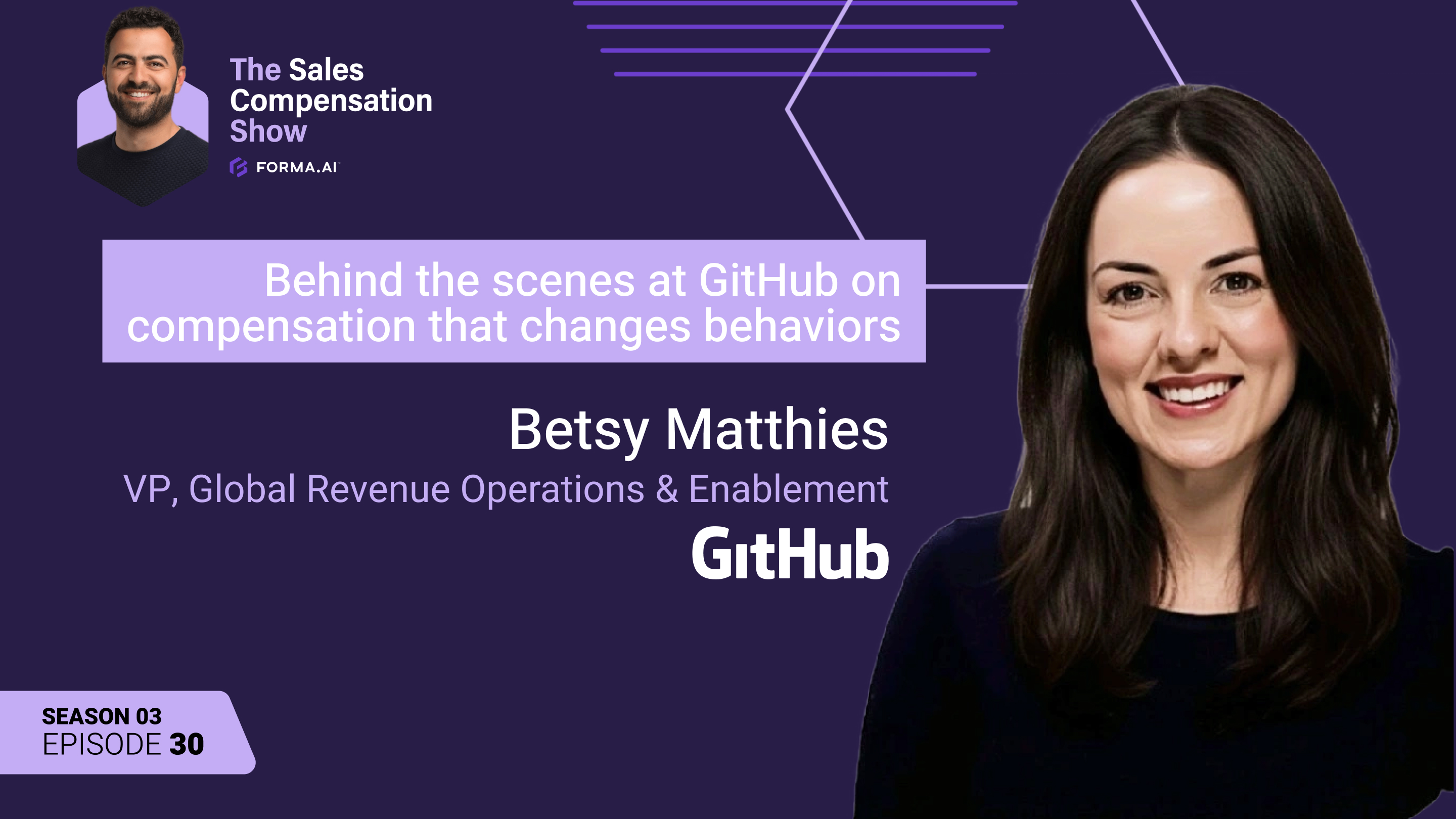
GitHub's VP of Global Revenue Betsy Matthies on comp that changes behavior
GitHub's VP of Global Revenue Betsy Matthies on comp that changes behavior
GitHub’s RevOps leader shares how she approaches sales compensation, drives the right behaviors, and manages change—plus why data hygiene matters for AI.


GitHub's VP of Global Revenue Betsy Matthies on comp that changes behavior
GitHub’s RevOps leader shares how she approaches sales compensation, drives the right behaviors, and manages change—plus why data hygiene matters for AI.
GitHub's VP of Global Revenue Betsy Matthies on comp that changes behavior
GitHub’s RevOps leader shares how she approaches sales compensation, drives the right behaviors, and manages change—plus why data hygiene matters for AI.
GitHub's VP of Global Revenue Betsy Matthies on comp that changes behavior
GitHub’s RevOps leader shares how she approaches sales compensation, drives the right behaviors, and manages change—plus why data hygiene matters for AI.
If you’re leading sales compensation or RevOps right now, you’re probably living inside a big ol' contradiction.
On one side: every business wants precision (everything from cleaner forecasting to more productive sellers, to better coverage and higher ROI on headcount.
On the other hand, though, your sellers want simplicity and confidence. Clarity they can feel, instead of a spreadsheet they have to decode.
This is why Betsy Matthies happens to make such a great guest on The Sales Compensation Show podcast.
Betsy is the VP of Global Revenue Operations & Enablement at GitHub, and didn’t come up through classic ops. As she shared with us, she started her career in food and beverage sales (think routes, relationships, and far more tactical selling than other industries)—then she moved into tech and scaled into RevOps leadership.
Her hybrid skills are evident throughout this episode where Betsy thinks like a seller, designs like an operator, and communicates like a change leader.
In this conversation with our host and Forma.ai CEO, Nabeil Alazzam, Betsy shares:
- how to rewire comp when sellers are gaming the system,
- why “perfect math” fails without trust,
- what she sees senior leaders get wrong when they use comp to fix non-comp problems,
- and why AI will punish bad data hygiene, fast.
As always, we've rounded up some of our top highlights below, and you can bookmark the episode to listen in anytime on Spotify, Apple Podcasts, and YouTube.
Episode resources
- Connect with Betsy on LinkedIn
- Book recommendation: Make Your Bed by Admiral William H. McRaven
Be sure to eliminate “compensated drift” (when sellers protect earnings instead of revenue growth)
In one of the most practical moments of this episode, Betsy describes a pattern many comp teams will recognize instantly: when sellers lose volume, they stop hunting and start protecting with pricing.
In a prior organization she'd worked with, reps who lost a customer would raise prices on remaining accounts to “stay whole” in a 100% commission model. They'd effectively tax the base instead of rebuilding it. This led to the company bleeding volume and revenue while reps preserved pay.
Unfortunately, this is not a comp edge case. Rather it's a comp flaw that just reflects exactly what you’ve paid people to do if you're not careful with your incentive design.
So Betsy moved the organization away from pure commission autonomy and implemented three strategic buckets that paid for growth behaviors the business actually needed:
- New business + volume (reward the hunt)
- Account penetration (land-and-expand, additional cases/categories)
- High-margin private label products (align payouts to profitability)
This led to a double-digit incremental sales increase and a culture shift away from “price administrator” behavior toward a real growth motion.
Ultimately, this type of comp plan rewiring matters because the compensation plan is your priority-setting system. If you don’t explicitly pay for acquisition, expansion, and profitable mix, sellers will invent their own version of winning, and it won’t always match your strategy.
What should you do this quarter aligned to Betsy's advice?
- Run a simple “behavior audit” on your current plan: I.e. What would a rational seller do to protect earnings if pipeline dips?
- Identify your top two compensated drift patterns (or the top 1–2 “protect the paycheck” behaviors your plan enables). e.g., discounting to close anything, price hikes, a renewals-only focus, easy upsells, avoiding harder segments, channel conflict).
- Re-anchor to 3 outcomes max that reflect how your business grows: think net new growth, expansion, and profit/quality.
Betsy’s diagnosis is the key insight: when a plan makes it easier to protect earnings than to create new revenue, sellers will take the path of least resistance. That’s not a character issue—it’s incentive design.
A useful rule of thumb: make sure every plan has at least one clear lever that pays for creating new value, not just preserving what already exists. If you pay for retention, ensure there’s also a meaningful path to upside through expansion or profitable mix—so you don’t end up rewarding “maintenance mode.”
The math is the easy part. Trust is the ultimate product.
Betsy says it directly: you can build a perfect spreadsheet, but if reps don’t trust it, they won’t execute.
That lands because it’s true at two levels:
- Seller trust (Do I believe I can win?)
- Leadership trust (Do we believe this won’t blow up culture, attrition, or spend?)
Betsy’s approach to change management is not “announce and defend.” It’s bring people along—then prove it works. She talks about:
- getting full stakeholder buy-in (sellers, sales leaders, C-suite),
- vetting risks (attrition, unintended behaviors),
- and running a complete communication + follow-up flywheel—not a one-and-done rollout.
She also calls out something most teams underinvest in: pulse checks after launch. Not just to catch issues, but to earn credibility for future changes.
In short, she recognizes that comp design is only half the job. The other half is institutional confidence, or your ability to change the system again next year without triggering panic, politics, or performance drag.
Notice that Betsy doesn’t treat leadership skepticism as obstruction, but rather as governance. This mindset shift changes how you operate. Instead of trying to “get approval,” you create a shared risk model.
If you want comp changes to scale in your org, stop positioning stakeholders as blockers and start positioning them as risk owners. In other words:
- Finance owns spend variability.
- Sales leadership owns field execution and morale.
- RevOps owns measurement integrity and clarity.
- Enablement owns comprehension and reinforcement.
When these owners feel included early, you ship a plan, sure, but more importantly, you ship confidence.
Further, for your next rollout ensure that you build a “trust plan” alongside the comp plan:
- a rep-facing “How you win” narrative
- a manager-facing coaching script
- an exec-facing risk memo (what you tested, what you’re watching)
- Schedule two non-negotiable pulse checks: These could be at week 3 and week 8 post-launch.
- Instrument adoption: not just attainment—behavioral leading indicators tied to your buckets.
Stop using comp to fix non-comp problems (and stop making reps do math to choose a lead)
Betsy’s “faux pas” list of mistakes to avoid is a clean executive filter for comp decisions.
The first error she sees often? Trying to use a comp plan to fix a non-compensation problem.
If product-market fit is off, or sellers can’t articulate value, “doubling commission” doesn’t solve it. It just creates frustration and higher cost of sales.
The second mistake she urges leaders to watch out for? Complexity bloat. If a rep needs a calculator to figure out which lead is worth their time, you’ve already lost. She’s a firm believer in three buckets max and a plan you can explain “on a napkin” in ~30 seconds.
The implication here is that every extra lever you add to comp is also a cultural signal. It tells the field, “The core job isn’t enough. We’ll pay you extra to do it.” Do that too often and you train the org to wait for incentives.
As Betsy sees it, complexity creates opacity more than it creates control. And opacity then creates misallocation of seller time—the most expensive resource you have.
Instead, use comp to reinforce what matters, and use enablement + inspection to drive the rest.
Before adding a SPIFF or modifier toyour own comp strategy, answer one question:
“Is this compensating for a capability gap or a strategy gap?”
If yes, fix enablement, segmentation, pricing, messaging, or coverage first.
- Run a “napkin test” workshop:
- Ask 10 reps to explain the plan in 30 seconds.
- If they can’t, simplify—or clarify with better earnings visibility and examples.
- Cap “behavior asks” at three. If you need seven behaviors, you don’t need a more complex plan—you need a better operating cadence.
AI won’t save messy RevOps data—it will amplify it
Betsy’s hot take is delivered with the kind of bluntness senior operators appreciate:
AI can be a force multiplier—but if your data hygiene isn’t clean, don’t do it yet.
Otherwise you’re just creating “slop.”
She pushes the point further: with clean data, she sees a future where AI surfaces real-time insights to sellers so they can maximize compensation “down to the penny.” And she goes even hotter: the sellers who leverage AI more will make more money long-term, because they’ll allocate time to the highest ROI actions in their portfolio.
Then she adds the RevOps constraint that matters: if you’re using AI for forecasting, planning, mapping, comp calculations—the underlying data has to be accurate because the impacts are massive when it isn’t.
Overall, AI is becoming a performance layer, but in RevOps and comp, accuracy isn’t “nice to have.” It’s the difference between trust and chaos. If AI insights contradict payout reality, you'll lose credibility.
To prepare for AI, properly, over the next 60–90 days:
- Define a “Revenue Data Readiness” bar before scaling AI:
- clean account hierarchies
- consistent opportunity stages/definitions
- reliable product/SKU mapping
- trusted crediting logic
- Start with AI use cases that improve hygiene (dedupe, enrichment, activity capture validation) before AI that drives decisions (forecast, payout guidance).
- Treat “earnings visibility” as a prime AI use case—but only after the payout engine is dependable.
The near term opportunity is to use AI to reduce plan confusion, not increase it. Eventually, imagine every rep asking, “What’s the highest ROI action I can take this week to move my earnings?” and getting a reliable answer that matches your crediting rules. That’s not just productivity—that’s trust at scale. You can build this over time.
Comp is strategy made executable
Betsy’s anecdotes throughout this episode land because they’re not theoretical. They’re about what happens when incentives collide with real human behavior: reps protect, leaders worry, plans bloat, and the business pays the price.
The upside is real too, though. When you anchor comp to the few outcomes that matter, bring stakeholders along, and protect trust with follow-through, you don’t just change payouts—you change the operating system of performance.
And that’s the career accelerator in this episode for RevOps and sales comp leaders: stop being the team that “runs comp.” Become the team that makes strategy executable.
Want more insights like this? Subscribe to The Sales Compensation Show on Spotify, Apple Podcasts, or YouTube for bi-weekly episodes featuring the revenue leaders behind today’s fastest-growing companies.
.jpg)


