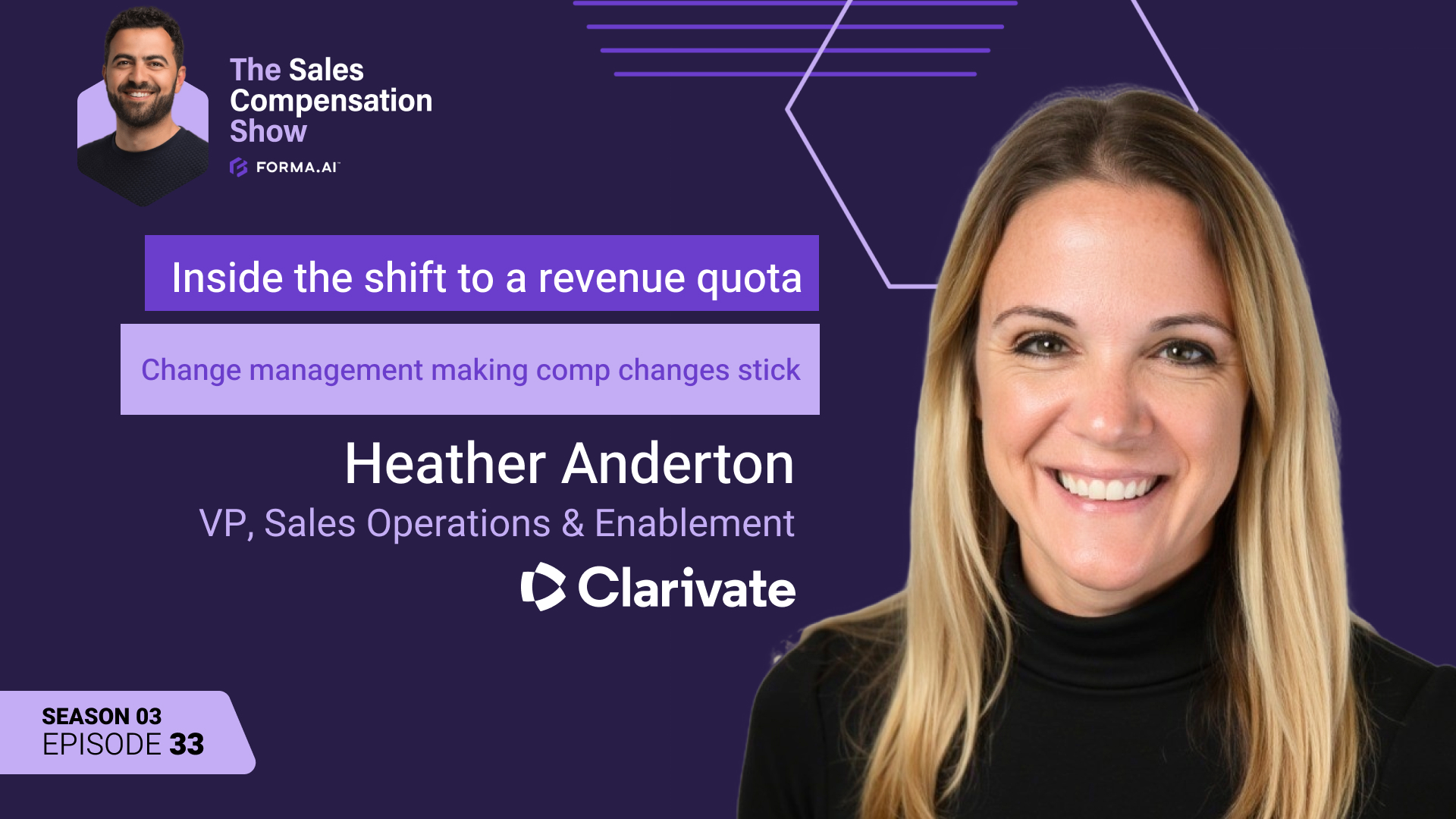
Inside Clarivate’s revenue quota shift: what it takes to make comp change stick
Inside Clarivate’s revenue quota shift: what it takes to make comp change stick
Learn how Clarivate is aligning sales compensation to revenue, reducing SPIFF reliance, and improving RevOps change management.


Inside Clarivate’s revenue quota shift: what it takes to make comp change stick
Learn how Clarivate is aligning sales compensation to revenue, reducing SPIFF reliance, and improving RevOps change management.
Inside Clarivate’s revenue quota shift: what it takes to make comp change stick
Learn how Clarivate is aligning sales compensation to revenue, reducing SPIFF reliance, and improving RevOps change management.
Inside Clarivate’s revenue quota shift: what it takes to make comp change stick
Learn how Clarivate is aligning sales compensation to revenue, reducing SPIFF reliance, and improving RevOps change management.
Compensation leaders rarely get to redesign incentives under ideal conditions. More often, the business has already outgrown a given metric, the field is used to a certain way of winning, and the data foundation's still catching up.
Which is why this conversation with Heather Anderton, Vice President of Sales Operations and Enablement, is so relevant. In this episode of The Sales Compensation Show, Heather takes us inside Clarivate's move toward a revenue quota and the very real change management that comes with it.
It's a real look at what happens when a company decides its incentives need to better reflect the outcome the business really wants. Even when the rollout will no doubt be complex, the systems will be imperfect, and sellers need support to understand what changes for them.
Heather’s perspective is especially compelling because she's seen this challenge from multiple angles: first through her background in finance and planning, then in sales ops leadership, and now in a role that brings sales ops and enablement together at Clarivate.
Below we'll walk through the lessons she shared with us with takeaways on:
- why compensation metrics have to match business reality
- how to bring sellers along even when the data is not perfect
- why simplifying the core plan can be more powerful than adding SPIFFs
- plus how combining sales ops with enablement can make major changes far easier to land
Bookmark the entire conversation to watch on YouTube, on Spotify, and Apple Podcasts.
Episode resources
- Connect with Heather on LinkedIn
When the metric stops matching the business, the plan must change
To start, Clarivate didn't move toward a revenue-based quota because it sounded cleaner on paper. The shift came actually came about when Heather and her team saw that bookings were no longer capturing enough of what the business really cared about.
As she shared, a significant portion of revenue was evergreen and recurring, yet that value was missing from seller quotas. This created an obvious disconnect where sellers could be rewarded for the initial deal without enough accountability for what happened after the sale.
The tipping point for change came from the data analysis Clarivate did with a third party. Heather shared that some reps were at 300% of bookings quota while their territories were down in revenue year over year. Simultaneously, others were posting double-digit revenue growth but weren't even hitting their OTE because their bookings performance looked weaker. This data ultimately revealed the plan was not consistently rewarding the behavior the business most wanted to see.
Consequently, it's what made the move to revenue quota more than a compensation redesign. This was a business alignment decision.
As Heather explains, the right metric is the one that reflects the outcome the company is actually trying to drive. In Clarivate’s case, this meant bringing more of the ongoing customer relationship into the plan, even if this shift would be harder to operationalize.
The lesson here? For leaders considering a similar shift, the strongest case for change is not that a new metric feels more modern. It's that the current one is no longer aligned to the business outcome you need the field to drive. Before pushing for a major plan change, get the data to show where payout mechanics and business outcomes have drifted apart. Compare quota attainment and earnings against the downstream business outcome you say matters most. Then look for the gap.
This exercise often helps you make the case for change. Ultimately, compensation plans don't usually fail loudly at first. They keep paying, they look operational. Then, over time, leaders realize they have been funding the wrong behavior all along.
A comp change only lands when the field can see the upside
Importantly, with the shift, Clarivate is not asking sellers to handle a tougher metric without changing the experience on the other side. Heather explains that the team simplified the plan by reducing the number of achievement tiers, making acceleration easier to reach and more rewarding once reps got there. They're also introducing a 75% threshold and increasing upside above quota.
So, the message to the field was clear: this wasn't a change designed to shift more risk onto sellers. But rather, to better align performance to revenue, while still making strong performance meaningfully worth it.
This matters because sellers don't experience comp changes as strategy. They experience the changes through payout mechanics, perceived effort, and confidence in whether the plan will really work. Clarivate’s rollout recognized this from the start.
Here's Heather on the change management and rollout aspect:
Heather's especially clear on the fact that once you decide to make a change this significant, any perceived hesitation creates confusion. Which is why her team did not treat rollout as a one-way announcement. Even as it was considered, they brought regional and frontline leaders into the conversation early, then later, the team reinforced the change through training sessions, sales kickoff discussions, and live in-person, scenario-based comp sessions where reps could pressure-test the plan against their actual territories.
Heather's also candid that the data foundation her team was dealing with was not perfect. Revenue data and sales data were still being reconciled, and the team had to build confidence while improving the model in flight. Their stance was they would launch at 80%, be transparent, and make it better every month. This iterative approach helped preserve trust for a big transformation.
Overall, a major comp change is a credibility exercise. The economics, the enablement, and the confidence story all have to work together. If one lags, the plan will feel shakier than it actually is.
If you can't prove the lift, SPIFF spend gets harder to defend
Heather’s take on SPIFFs is one built from the data in her situation. Clarivate had used SPIFFs for years across different priorities, but after measuring the outcomes, her team could not find a direct enough correlation between the extra incentive spend and improved incremental performance. Put simply, they were paying more without enough evidence that the money was driving results that would not have happened anyway.
That finding led to a bigger decision. Instead of continuing to layer short-term incentives on top of the plan, Clarivate shifted the emphasis back into the core comp plan. Heather shared that sellers themselves indicated they'd rather see the comp budget's money reflected in the core plan than in episodic SPIFFs that felt confusing and disconnected from how customers actually buy.
The clip below gets at the heart of the issue: side incentives are easy to announce, but much harder to justify if they aren't truly changing behavior.
Heather is not arguing that every SPIFF is bad. Rather, she's saying the burden of proof should be much higher than it usually is.
In other words, the conversation should always start with “What behavior are we trying to change, and how will we know if the extra spend worked?”
That is where Nabeil adds an important nuance, too. In some cases, SPIFFs can work. But only when the behavior is genuinely shiftable in the time window available. In longer-cycle, relationship-driven motions, that is often a much harder case to make. In those environments, a stronger core plan may do far more to shape seller behavior than another temporary incentive layered on top.
The strongest comp leaders do not let systems define the plan
Heather also reflects in this episode on how her own thinking has evolved over time when it comes to how to shape behavior meaningfully and how systems fit in. Earlier in her career, commissions lived in a more centralized structure with a fixed menu of plan options. The organization limited design to what the system could handle and avoided exceptions or customization. Over time, she came to see the downside of that model: once plan design is constrained by tooling, it becomes much harder to reward the behaviors the business actually wants.
Ultimately the goal of sales comp leadership isn't to force strategy into the shape of the current system. It's to design for the business outcome first, then solve the operational complexity required to support it.
Sometimes this means carrying more manual work in the short term. Sometimes it means building toward a better future state instead of waiting for perfect tooling on day one. Either way, the system cannot become the reason a stronger plan never gets implemented.
Operations teams have to decide whether they serve the business strategy or preserve the comfort of the current process.
This mindset is so powerful because it changes how the field experiences the sales ops and commissions team. When the function is known for helping operationalize better ideas, even when execution is harder, trust grows. That is part of what Heather describes in the episode: flexibility earns credibility, and credibility makes harder conversations easier when real tradeoffs do need to be made.
There's also an operating model lesson here. At Clarivate, enablement and comp sit within the same leadership structure, which helps ensure plan changes are not only designed well, but explained well. The plan, the training, and the field message stay tightly connected. For senior leaders, that is the broader takeaway: compensation design, enablement, and operational execution work better when they are treated as connected levers rather than separate lanes.
Encompassing some of the points made throughout the episode here, there are four questions worth asking before you change your plan:
- What outcome are we actually trying to reward?
- Can the field clearly see the upside under the new design?
- Are side incentives driving incremental behavior, or just adding payout?
- Are our systems supporting the strategy, or quietly constraining it?
Want more insights like this? Subscribe to The Sales Compensation Show on Spotify or Apple Podcasts, or YouTube for bi-weekly episodes featuring the revenue leaders behind today’s fastest-growing companies.
.jpg)
.jpg)


