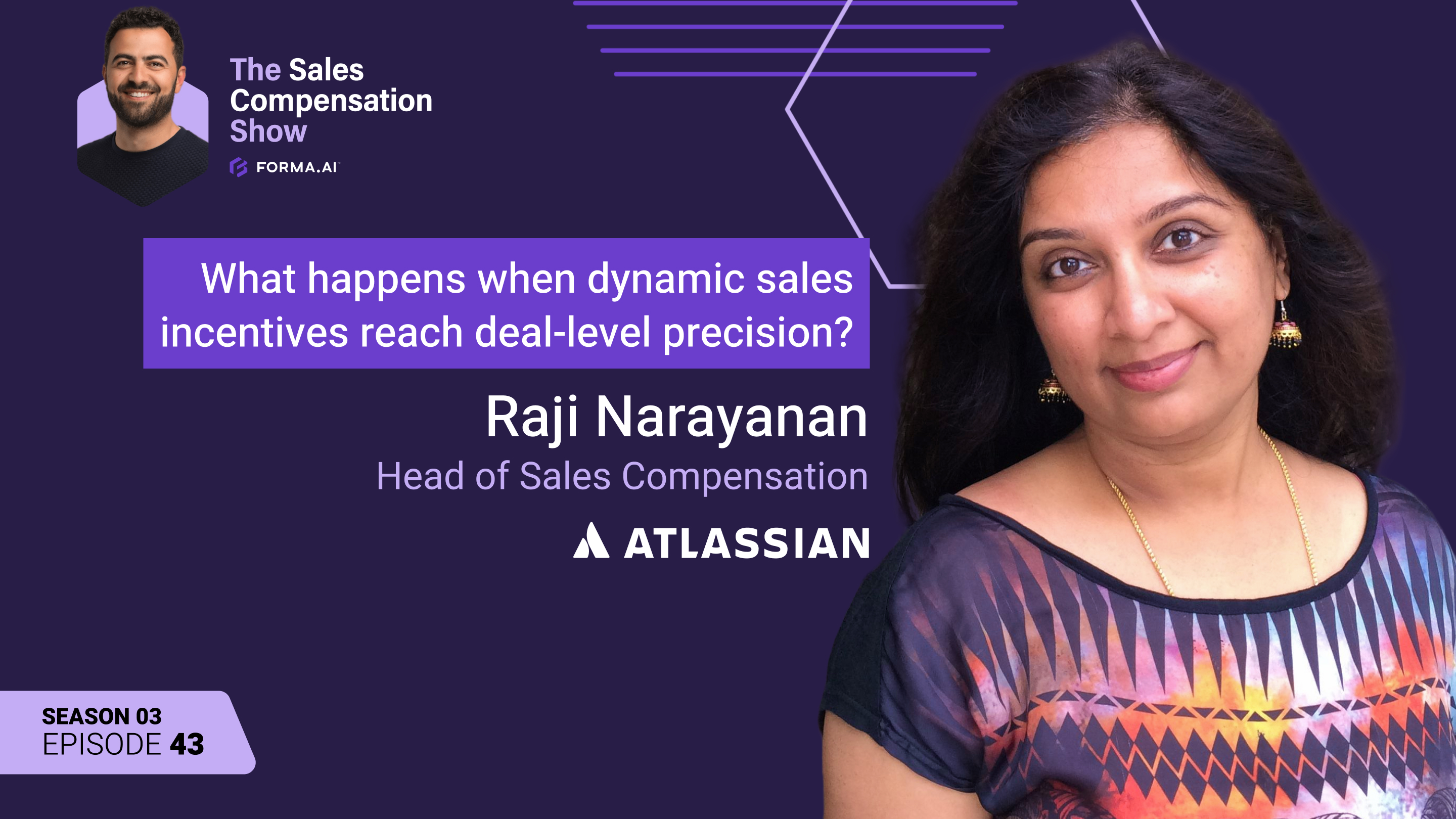
Atlassian’s head of sales compensation on where the industry goes next
Atlassian’s head of sales compensation on where the industry goes next
Atlassian’s Raji Narayanan shares considerations for simplifying sales comp, protecting seller mindshare, and preparing for more dynamic, AI-enabled incentives.


Atlassian’s head of sales compensation on where the industry goes next
Atlassian’s Raji Narayanan shares considerations for simplifying sales comp, protecting seller mindshare, and preparing for more dynamic, AI-enabled incentives.
Atlassian’s head of sales compensation on where the industry goes next
Atlassian’s Raji Narayanan shares considerations for simplifying sales comp, protecting seller mindshare, and preparing for more dynamic, AI-enabled incentives.
Atlassian’s head of sales compensation on where the industry goes next
Atlassian’s Raji Narayanan shares considerations for simplifying sales comp, protecting seller mindshare, and preparing for more dynamic, AI-enabled incentives.
In a modern market reality, product bets evolve and competitive dynamics can shift fast. Leadership may identify a new priority in March or September and want seller behavior to adjust long before the next annual planning cycle.
This presents challenge for many sales compensation leaders. The annual plan's designed to give sellers a stable set of priorities and a predictable path to earning variable compensation.
Yet the business rarely stays still for twelve months.
Historically, responding mid-cycle has often meant layering on SPIFFs or another broad incentive to redirect attention. But then every addition competes for finite mindshare, and too much change can risk making the comp system harder to understand and trust.
But now, amid access to better data, automation, and AI, the available toolkit is starting to expand.
Technology is creating the possibility of responding to changing business priorities with much more precision and speed. Instead of applying the same incentive broadly, for example, dynamic compensation could one day direct incremental upside toward a particular opportunity, account, or selling motion where the business needs it most.
This gets explored in our latest conversation with Raji Narayanan, Head of Sales Compensation at Atlassian.
Raji has spent more than 20 years designing and operating incentive programs across Broadcom, Dell, SAP, and now Atlassian. Rather than retracing history, though, Forma.ai CEO Nabeil Alazzam and Raji spend much of this episode looking forward.
They discuss what happens when some of the constraints that have historically shaped comp start to disappear. I.e.:
- Could incentive budgets be deployed dynamically against the opportunities where they have the highest expected return?
- Could QBR priorities, next-best-action systems, pipeline data, and compensation begin informing one another?
- Could comp gain more precision without asking sellers to handle more complexity?
Raji sees a lot of potential in more precise, dynamic incentives, while drawing a clear line around what compensation still has to protect. The result is a conversation that's as much about the discipline required for the hypotehtical future of sales comp as the technology that could enable it.
Check out the full episode below, or on Spotify, or Apple Podcasts.
Episode resources
- Connect with Raji on LinkedIn
- Book recommendation: Jonathan Livingston Seagull by Richard Bach
Design for what you can execute
When it comes to plan design, one of Raji shares here success comes down to starting with two questions (which need to be answered in parallel):
- Should we do it?
- Can we do it?
As she shares, too often, compensation strategy gets perfected conceptually first. The desired outcomes look great in a deck, but then the plan reaches execution and the compromises begin.
The data can't measure something cleanly, the systems can't support a mechanic, or the required process won't be ready in time.
One workaround leads to another. And, eventually, the plan that gets deployed barely resembles the strategy everyone approved.
This changes where feasibility belongs in your planning process as a leader. In other words, execution should influence design before the design's final.
This means testing proposed mechanics against the actual operating environment.
- If a measure matters strategically, can you calculate it reliably enough that sellers will trust it?
- If the required data doesn't exist today, can it realistically exist by launch?
- If you need a proxy, does that proxy preserve the behavior you originally wanted to encourage?
Raji’s answer, however, isn't to let current systems permanently dictate strategy. Instead, she uses a crawl, walk, run roadmap to align stakeholders on the destination, then makes an explicit decision about how quickly the organization can credibly get there.
Ultimately, this is a solid definition of sales comp maturity versus sophistication for its own sake. In other words, mature teams know where they're going and how much change their operating model can handle en route.
An over-engineered plan is a prioritization problem
The pressure to add “just one more thing” is familiar to anyone who owns incentive design.
Marketing, Product, Finance, and Sales leadership each want something different and each request can be perfectly defensible.
But then, as Raji shares, somebody has to sell against the finished plan. Here's Raji on how the combined experience just doesn't add up.
While a compensation team can process every stakeholder request independently, sellers receive all the priorities at once and have to decide what deserves attention.
Once you look at complexity through this lens, simplifying a plan becomes an exercise in prioritization.
- Which outcomes matter enough to command seller behavior?
- Which asks belong in the compensation plan at all?
- Which can be handled more effectively through enablement, management, process, pricing, or another mechanism?
Raji makes the same point about stacking SPIFFs. Even if the company can afford to fund every incentive, seller mindshare's still constrained.
Give someone thirteen priorities and they'll choose a subset themselves. At which point, the compensation team has surrendered control over which behaviors will win.
Further, Raji describes organizations effectively competing with themselves as different product groups fight for more incentive weight. Push something hard enough without a sufficient business case and it can make its way onto a deal only to become shelfware later.
The takeaway? Make sure you're forcing the tradeoffs into the open with your stakeholders during planning season. Watch the full episode for how Raji has typically brought visibility to this in her past and what tends to work to make the case.
In the future, we'll replace the incentive sledgehammer with a scalpel
Today, a strategic priority too often becomes a broad SPIFF.
When an organization wants more competitive takeouts, a certain product attached, longer-term deals, or penetration into a priority segment, an incentive gets created that applies across a large population for a fixed period and hopes it moves enough behavior in the intended direction.
But this is where Raji sees the chance to make things far more targeted.
Where the current model's a sledgehammer, Raji says the ideal future-state is a scalpel.
She sees a future where the business can direct upside toward the specific opportunities where a behavior matters most:
Imagine connecting the information already generated through QBRs, forecasting, pipeline analysis, and next-best-action systems. The system could potentially recognize when a particular deal has disproportionate strategic value and surface incremental comp directly to the seller positioned to act on it.
- A competitive takeout sitting in the right stage of pipeline might carry additional upside for two weeks.
- Another opportunity may be worth more because it combines several strategically valuable attributes.
Raji compares the concept to Uber's surge pricing, with the incentive responding to the value of the opportunity in that moment.
Ultimately, instead of deciding months in advance which handful of priorities should receive broad incentive coverage, the business could theoretically direct part of its incentive budget toward the opportunities where it expects the greatest return. This type of precision might even reach the deal level.
This also reframes a challenge Raji raised earlier.
If seller mindshare's constrained, dynamic compensation would potentially help to keep the number of signals out to reps small while making the signals far more relevant to individuals and opportunity in front of them.
Raji suggests that a dynamic system could even potentially monitor incentive spend against a defined budget and self-correct as conditions change. If spend begins running high, available upside could adjust rather than leaving the organization to discover the overrun after the fact.
There are also behaviors that historically have been difficult to distinguish with traditional systems.
Raji gave the example of expansion within an account. Selling another product to the CIO you already work with is one motion, but opening an entirely new buying center with the CHRO may require materially more selling effort.
Today, systems often struggle to measure this distinction cleanly enough to compensate for it. But with better deal-level context and AI, Raji argues that previously invisible effort could become measurable.
As incentives become more dynamic, protect the earning path
Raji's discipline around plan simplicity becomes even more pronounced as the conversation turned toward the future of the comp function.
While Raji sees a path toward dynamic incentives, she also draws a clear line around where that should begin and end:
Her sticking point is seller predictability. A rep should still be able to look at their core plan and understand the path to earning their variable comp. If they have a quota and achieve it, that fundamental earning relationship needs to remain clear. As Raji insists:
The dynamic layer belongs primarily in the upside.
This matters because greater technical sophistication can quickly become greater perceived opacity. Compensation only influences behavior while sellers believe they understand the economic bargain in front of them.
In other words, to make dynamic comp work, at minimum you need:
- A core earning path: Stable enough that a seller knows how to reach 100% of variable compensation.
- A dynamic opportunity layer: Additional upside attached to timely strategic priorities.
- Guardrails: Clear eligibility, fairness, budget controls, and enough transparency that the additional incentive feels actionable rather than arbitrary.
When it comes to AI-enabled compensation design in reality, it's largely going to come down to how much dynamism you can introduce while preserving the trust and clarity the compensation system depends on.
Want more insights like this? Subscribe to The Sales Compensation Show on Spotify or Apple Podcasts, or YouTube for bi-weekly episodes featuring the revenue leaders behind today’s fastest-growing companies.

.jpg)
.jpg)


