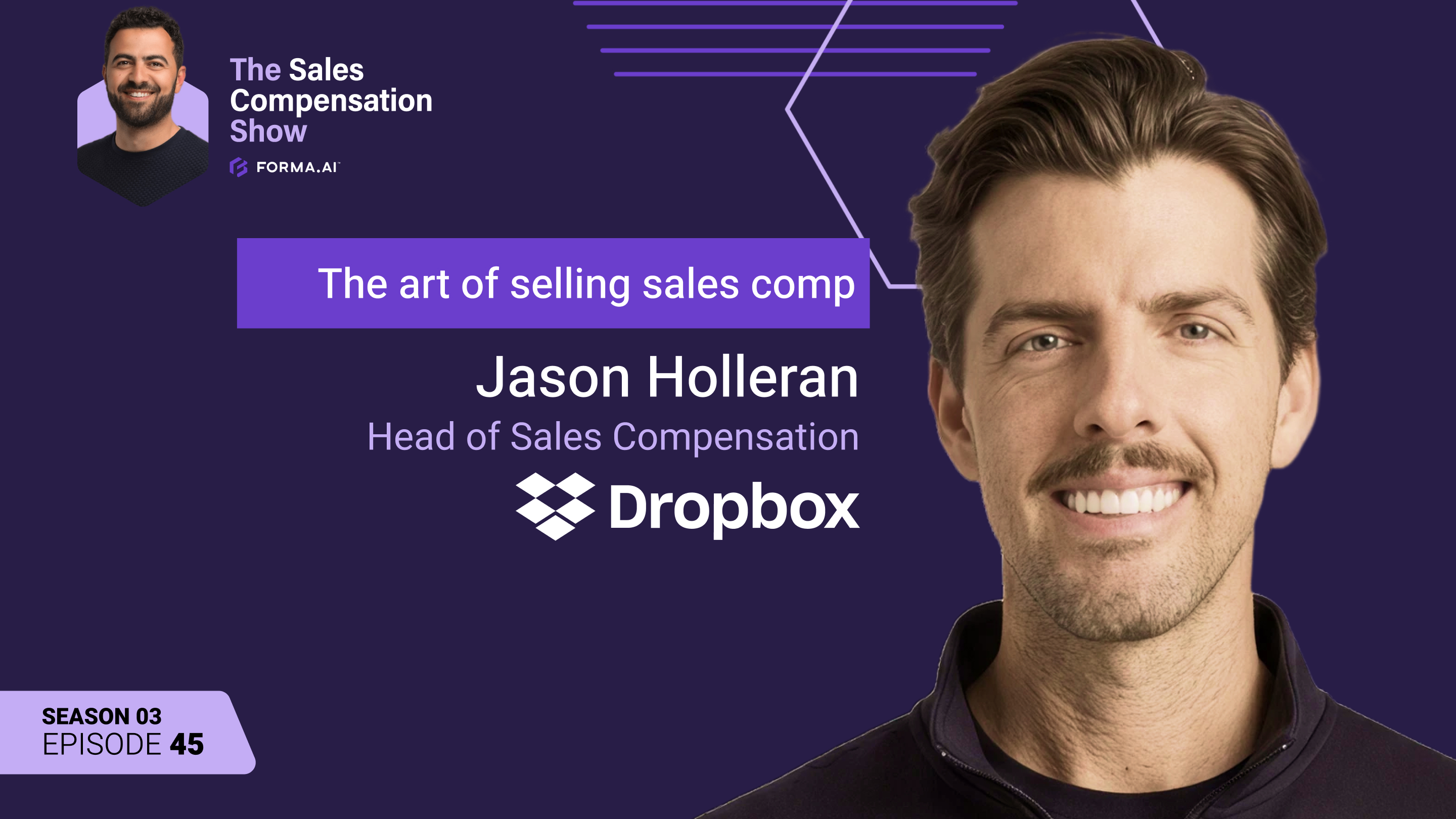
The art of selling sales comp: Lessons from Dropbox's Jason Halloran
How Dropbox's Head of Sales Compensation approaches change management, seller experience, and the next evolution of the function.
The art of selling sales comp: Lessons from Dropbox's Jason Halloran
How Dropbox's Head of Sales Compensation approaches change management, seller experience, and the next evolution of the function.
How Dropbox's Head of Sales Compensation approaches change management, seller experience, and the next evolution of the function.
What if one of the biggest opportunities to improve sales compensation effectiveness has little to do with compensation mechanics?
Organizations invest enormous effort in getting incentive plans right: selecting the right measures, modeling payout curves, reconciling quotas, and ensuring every commission calculation is accurate.
But there's another test of effectiveness that's much harder to capture in a spreadsheet.
Do sellers understand the plan, believe in it, and know how to use it to win?
For Jason Holleran, Head of Sales Compensation at Dropbox, this consideration sits at the center of his approach.
Jason has spent his career designing and operating incentive programs across industries, including SaaS, healthcare, media, and travel. His experience has reinforced his conviction that effective sales compensation demands equal parts analytical rigor, commercial understanding, and people skills.
And with AI accelerating change across go-to-market organizations, those last two capabilities are becoming even more important.
In this episode of The Sales Compensation Show, Jason joins Forma.ai CEO Nabeil Alazzam to explore what it takes to make compensation a more strategic driver of sales performance.
Together, they challenge some conventional thinking around how incentive programs are designed and managed.
- What if sales comp leaders put as much effort into selling their plans as they do designing them?
- Why even a better compensation plan can fail to win over sellers, and what leaders can do months before rollout to change that
- And, as AI takes on more of the administrative workload, what higher-value work might compensation teams finally have the capacity to tackle?
Be sure to bookmark and queue up the full episode on YouTube, Spotify, or Apple Podcasts.
Episode resources
- Connect with Jason on LinkedIn
Your compensation plan needs a sales pitch of its own
It's still not uncommon to invest months in designing an incentive plan that perfectly aligns with your company's growth strategy, only to discover that sellers barely think about it when deciding how to spend their time.
But for all the analytical rigor that goes into compensation design, this disconnect represents a significant missed opportunity. And it's exactly what Jason believes the profession needs to rethink.
As he shares:
Sales comp needs to be sexier.
In other words, compensation leaders have something to learn from the very people they're designing incentives for: the art of selling. Here's Jason's hot take:
For Jason, the ultimate measure of his success is the success of his go-to-market teams. Which means giving as much consideration to how a plan is experienced, communicated, and embraced as to how it's engineered.
During the conversation, Nabeil draws a parallel with consumer loyalty programs. Think about how brands like Starbucks approach incentives: every new reward is marketed, the experience is carefully designed, and customers are regularly reminded of the opportunities available to them.
What would it look like to bring that same level of intentionality or even branding to enterprise sales compensation?
Consider a typical incentive program. A seller receives a plan document, attends an annual kickoff, and may spend the rest of the year interacting with compensation primarily when checking a statement or questioning a payout.
Compare that with Jason's approach.
He asks sales leaders for three to five minutes during sales all-hands meetings, using the time to celebrate wins, highlight SPIFFs, discuss leaderboards, and keep sellers engaged with the opportunities in front of them.
It's a simple practice to keep incentives relevant to the decisions sellers make every day.
Incentive communication should be continuous because the behavior you're trying to influence is continuous.
For compensation leaders, this means you need to treat incentive adoption as an ongoing responsibility with several dimensions:
- Clarity: Can sellers quickly understand how their actions translate into earnings? Jason applies this test directly to commission statements and dashboards, evaluating the experience from a seller's perspective rather than an administrator's.
- Visibility: Are sellers regularly reminded which opportunities and performance measures matter, or do those incentives disappear from view after kickoff?
- Motivation: Do communications make the connection between individual success and business priorities tangible, particularly as priorities evolve throughout the year?
There's a competitive dimension to this, too. As Nabeil suggests, an organization that makes it significantly easier for sellers to understand their incentives and maximize their earnings could create a meaningful advantage in attracting and retaining top performers.
It raises the bar for what compensation leaders should aspire to deliver: an incentive experience that actively contributes to seller success.
And if you're going to take that responsibility seriously, the work of selling the plan needs to begin long before sellers receive it.
Socialize plan changes long before you announce them
Even the most carefully designed incentive plan can meet resistance when it reaches the field.
Jason has a straightforward explanation for why: compensation is personal. Changes to how people earn a living can be unsettling, even when the changes ultimately work in their favor.
His solution is to begin the conversation much earlier.
In a calendar-year planning cycle, Jason prefers to kick off annual compensation planning as early as possible, once he has two quarters of performance data to examine.
This gives him time to explore what's working, identify potential changes, and involve incentive-eligible teams in conversations about where the business is headed.
Crucially, it also gives sellers time to process what might be coming.
The bigger lesson is that rollout readiness should influence the planning timeline just as much as modeling and approval requirements.
Consider a company introducing a new incentive tied to a strategic growth priority. Your compensation team might spend months validating the economics, gaining Finance approval, and preparing system changes.
Yet if sellers first hear about the new measure when their compensation documents arrive, the organization has created an avoidable adoption challenge.
An earlier feedback loop serves two purposes.
- First, it gives compensation leaders a chance to identify where proposed changes could introduce confusion, unintended consequences, or practical obstacles.
- Second, it helps sellers understand the business rationale behind the changes before they become personally accountable for them.
Ultimately, build stakeholder engagement into the plan-design process, rather than leaving it to the communications phase.
This means making room for frontline feedback alongside financial modeling, testing how sellers interpret proposed measures, and equipping managers to explain the strategic intent behind the plan.
By launch, sellers should already have some familiarity with what's changing and why.
This won't guarantee universal enthusiasm. But it can substantially improve the conditions for adoption.
The challenge, of course, is capacity. Building stronger relationships with the field, supporting change management, and keeping sellers engaged all require time. And for compensation teams already consumed by administration, that time can be difficult to find.
Which brings us to another opportunity Jason sees emerging for the function.
Use AI to give the compensation function more room to create value
Compensation teams are responsible for some of the most operationally demanding processes in the revenue organization. And as Jason observes, the pace of change isn't slowing.
This is where he sees a particularly promising opportunity for AI.
Jason describes increasingly incorporating AI into training, onboarding, rollout, calculations, and audit-related work. One application he's especially interested in is AI-powered inquiry handling.
Consider how much time a compensation team spends responding to recurring questions about plan terms, eligibility, calculations, and payout mechanics.
If an AI agent can reliably answer routine inquiries using approved plan documentation and supporting information, compensation specialists can redirect more attention toward higher-value work.
For Jason, the attraction is the opportunity to deliver better service to sellers rather than repeatedly typing answers to similar emails.
There's a second opportunity, too: making compensation systems easier for business users to work with. Jason is interested in the ability to prompt tools to build or configure solutions, reducing the technical barriers between an idea and its execution.
But there's a critical caveat.
AI-enabled compensation operations require trustworthy information and appropriate controls.
Jason acknowledges the sensitivity of compensation data and the importance of how information is provided to AI models. And Nabeil builds on this point, emphasizing the need for data governance, access permissions, and consistent business definitions before AI can reliably support more sophisticated workflows.
For senior leaders assessing where to invest, the most useful starting point is to examine which activities consume the team's capacity without requiring much judgment. Routine inquiries are an obvious candidate. So are other repetitive workflows where accurate, governed automation could reduce manual effort.
Then consider what higher-value activities that capacity could support: faster analysis of incentive effectiveness, more direct collaboration with GTM leaders, better seller enablement, or more responsive plan changes.
Beyond hours saved, the greater opportunity is to increase the contribution compensation teams can make to commercial performance.
Want to hear from more sales comp professionals? Subscribe to The Sales Compensation Show on Spotify or Apple Podcasts, or YouTube for bi-weekly episodes featuring the revenue leaders behind today’s fastest-growing companies.