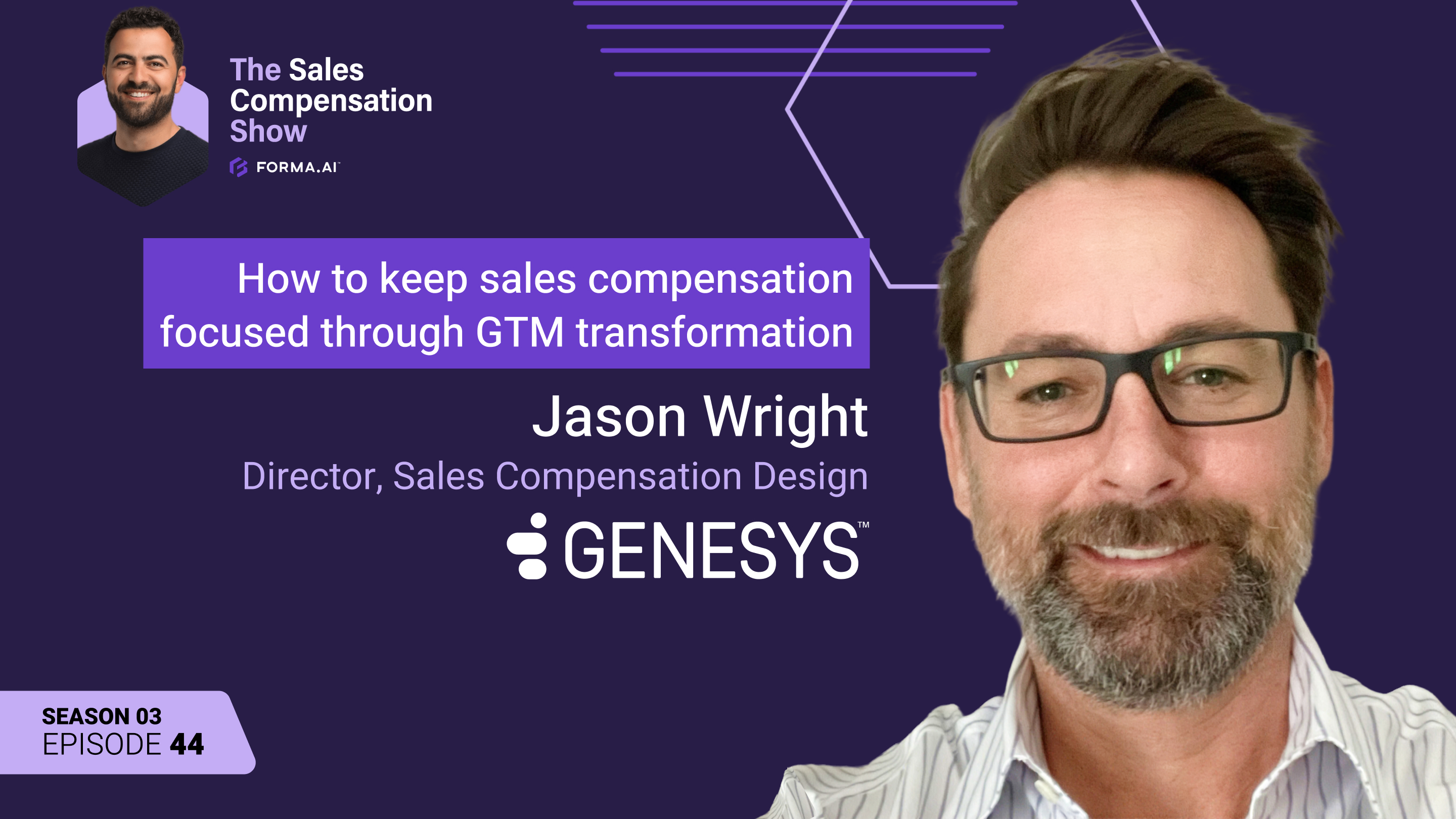
Genesys’ Jason Wright on keeping sales compensation focused through GTM transformation
Genesys’ Jason Wright on keeping sales compensation focused through GTM transformation
Genesys’ Jason Wright explains how to keep sales comp focused, design from seller reality, and make new GTM motions stick.


Genesys’ Jason Wright on keeping sales compensation focused through GTM transformation
Genesys’ Jason Wright explains how to keep sales comp focused, design from seller reality, and make new GTM motions stick.
Genesys’ Jason Wright on keeping sales compensation focused through GTM transformation
Genesys’ Jason Wright explains how to keep sales comp focused, design from seller reality, and make new GTM motions stick.
Genesys’ Jason Wright on keeping sales compensation focused through GTM transformation
Genesys’ Jason Wright explains how to keep sales comp focused, design from seller reality, and make new GTM motions stick.
Sales compensation typically has a habit of getting more complicated right when the business can least afford it.
Like when the sales motion changes or leadership wants more AI attach, different deal economics, longer terms, or better cross-sell.
Suddenly every strategic priority is competing for a place in the incentive plan.
Jason Wright is no stranger to what happens next.
Now Director of Sales Compensation Design at Genesys, Jason has spent roughly two decades working across sales compensation, operations, implementations, and design at organizations including Charter, HPE, Rapid7, and Xerox. And importantly, much of that experience came while those businesses were navigating major shifts in how they sold.
This gives him a particularly useful perspective for the current moment.
As more companies rethink their GTM motions around AI, recurring revenue, product mix, and changing buyer behavior, the hard part is actuallydeciding what sales compensation should carry, what should be solved elsewhere, and how much change the sales organization can handle without quickly retreating to the old model.
In this episode of The Sales Compensation Show, Jason joins Forma.ai CEO Nabeil Alazzam to unpack what he’s learned about keeping incentive design focused while the business underneath it is changing.
We’ve summed up our favorite takeaways below. It’s a great episode to queue up right away, or bookmark on Spotify, Apple Podcasts, and YouTube.
Episode resources
- Connect with Jason on LinkedIn
- Book recommendation: Talent Is Overrated by Geoff Colvin
A simple plan can still hide a very complicated compensation system
To Jason, two or three measures on a plan document doesn’t necessarily mean you've achieved an experience that's simple.
In fact, he's seen the exact opposite.
At Xerox, Jason waslked into an environment with 300+ sales plan iterations. In many cases, what made one “plan” different from another was all the different crediting logic, pay curves, regional requirements, or the systems feeding the calculation.
He’s also seen organizations technically operate with one sales plan while crediting the same measure six different ways depending on geography and available data.
So we need a more useful definition of simplicity.
For the seller, simplicity it's being able to understand the path from what I sold → what gets credited → how that compares to my target → what I’m going to earn.
If any link in that chain becomes opaque, the plan can be structurally simple and still feel impossible to navigate.
For senior sales comp leaders, this changes where to look for complexity.
Before celebrating a “simplified” plan, ask:
- Can the seller predict how a real deal will be credited?
- Does the definition of performance stay consistent between quota setting, reporting, and compensation?
- Are regional or system differences creating invisible variants of the same plan?
- Could a seller explain their earnings without needing the comp team to reconstruct the calculation for them?
This is where plan design starts to become a cross-functional architecture problem.
Jason points to the importance of partnering closely with IT and revenue intelligence teams because the data layer often determines how simple the final seller experience can actually become. If definitions, systems, and crediting logic diverge upstream, compensation inherits that complexity downstream.
The goal, then, isn’t just fewer measures.
It’s experienced simplicity: a seller can understand what matters, see how their actions translate into credit, and trust the connection between performance and pay.
And the best way to test if you’ve achieved this? Get much closer to the people using the plan.
Design the plan from the seller’s reality
A compensation team can know the plan perfectly and still misunderstand the work it is attempting to influence.
Jason shares he learned this early in his career.
While implementing a new system at Charter, he started joining sales calls to understand the environment firsthand: the customer interactions, the products reps had to navigate, and shape of a sales cycle.
Then he sent members of his team out to do the same.
The resulting reaction stuck with him....
Jason's team learned more in one day alongside sellers than they had trying to understand the role from their desks.
For Jason, it remains one of the most practical things a sales compensation org can do.
Ultimately, incentive design depends on assumptions about what sellers can see, control and change.
A metric can look perfectly logical at the planning table and feel almost meaningless in the field if the seller has limited influence over it. Even a seemingly small dispute can look very different once you understand everything else competing for a seller’s attention.
The context meaningfully changes design decisions.
It also changes how the comp function handles questions after launch. Jason emphasizes that compensation teams should understand the business they support rather than becoming isolated “calculators of commissions.” Knowing the sales process helps analysts diagnose whether a problem actually sits in the calculation, the CRM workflow, the quoting process or somewhere else entirely.
The takeaway here? Treat exposure to the field as part of plan governance.
You don’t need every analyst spending a week carrying quota. But a few hours walking through quote-to-cash with a rep, or observing how sellers interpret a new measure can expose assumptions that months of plan modeling will miss.
It becomes particularly critical when you’re asking sellers to work differently than they have before.
If variable pay feels guaranteed, changing the plan becomes a cultural problem
Sales compensation is supposed to create direction. But Jason points to a difficult dynamic that emerges in some mature sales organizations: over time, variable incentive can begin to feel less like pay contingent on performance and more like an expected component of annual earnings.
Once this happens, altering the plan carries a different psychological weight.
The business may be moving from transactional selling toward outcomes, or trying to shift product mix. Leadership sees the incentive plan as one mechanism for moving sellers with it.
The seller then may experience the same change as a threat to compensation they already consider theirs.
Jason argues that when variable incentive becomes culturally assumed as part of OTE and functions primarily as an attrition-prevention mechanism, it becomes much harder to use that same incentive to drive new behavior.
Bigger than a plan-design issue, this changes the risk calculation executives make when transformation reaches the field.
A new measure will inevitably create winners, losers and uncertainty. In businesses where sellers own deep customer relationships, leadership may worry that changing compensation will trigger attrition and put revenue at risk. Nabeil and Jason discuss the extreme version of this problem: losing the seller can feel synonymous with losing the customer.
The pressure can make organizations preserve legacy incentives long after their strategy has changed.
For senior leaders, you can't ignore attrition risk, but you must get much clearer about what the organization is asking sellers to become.
If the future motion requires different capabilities, different products or a different customer conversation, incentive design has to connect that strategic shift to the field early. Change management, manager enablement and a credible explanation of why the selling model is changing become part of compensation effectiveness.
Otherwise, every change feels arbitrary.
Jason has seen this play out across very different transformations, including the move from infrastructure-led selling toward more outcome- and services-oriented models and, more recently, shifts involving AI and product mix.
And that brings the conversation to perhaps the toughest leadership challenge in the episode...
Transformation stalls when leaders retreat at the first sign of friction
As Jason shared with us, most companies don’t abandon a transformation outright. The trouble starts when they soften it.
The strategy says the business has to move. Plans change. New expectations reach the field. Then resistance arrives: seller frustration, concerns about attrition, worries about customer coverage.
Leadership compromises. Then compromises again.
Jason describes the pattern as three steps forward, two steps back.
The danger of this is cumulative. Eighteen months or two years later, the company may discover that it technically changed the plan several times while never changing the selling model deeply enough to achieve the original objective.
Jason isn’t arguing for transformation at any cost. He explicitly acknowledges the balance leaders have to manage: push too aggressively and you can create uncovered territories, seller attrition and exposed customer relationships.
His point is about discipline once the strategic direction is clear.
If leadership has concluded that the existing motion will not support the future business, preserving every element of that motion because change creates noise simply extends the problem.
That has direct implications for how RevOps and compensation leaders structure transformation programs.
Before launch, align executives on what resistance you expect. Identify which signals would legitimately justify changing course and which are simply predictable consequences of asking people to behave differently. Build the seller and manager communication before objections arrive. And make sure leadership understands the cost of reversing direction as clearly as it understands the cost of pushing forward.
Otherwise, the loudest reaction can become the de facto governance mechanism.
Which is especially dangerous in sales compensation because incentives are personal. Every strategic decision eventually translates into someone’s paycheck.
Strong transformation governance creates enough conviction at the top that early noise becomes information to evaluate, rather than an automatic reason to undo the change.
Want more insights like this? Subscribe to The Sales Compensation Show on Spotify or Apple Podcasts, or YouTube for bi-weekly episodes featuring the revenue leaders behind today’s fastest-growing companies.